
Huawei’s Ultra-Capacity SSD: The Breakthrough Is Packaging, Not Better NAND
Huawei’s 61.44TB and 122.88TB SSDs, plus a reported 245TB roadmap, are not just “larger drives.” They show how China is trying to work around advanced-NAND restrictions through packaging, board design, and system-level optimization.
If the building cannot get taller, redesign the rooms
Modern 3D NAND increases capacity by stacking more layers in the same footprint. The simple apartment analogy is building a taller tower on the same land. But if restrictions make the most advanced NAND harder to access, direct competition becomes harder.
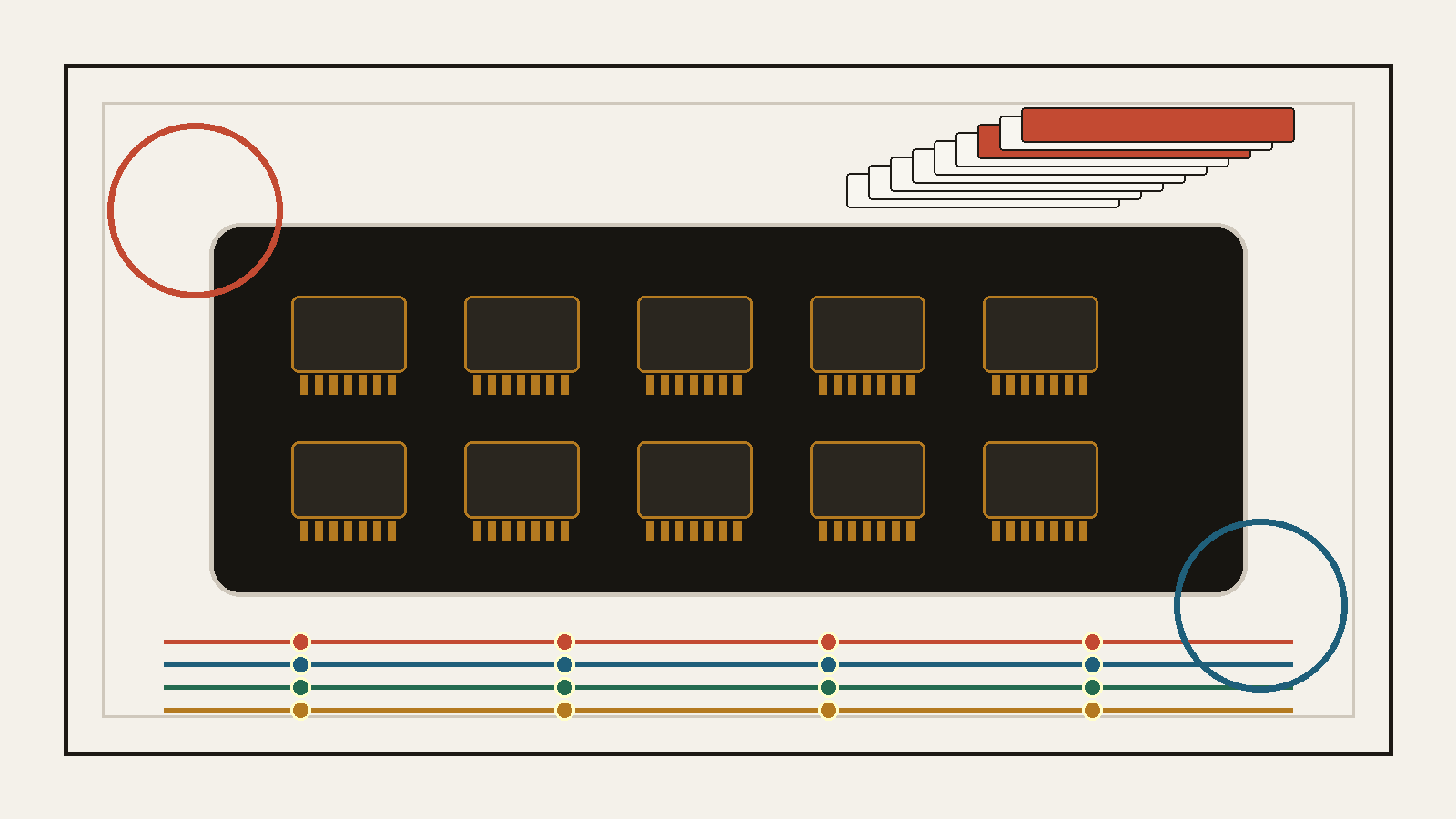
Huawei’s alternative is closer to redesigning the rooms inside the same building. Die-on-Board places NAND dies directly on the board rather than packaging each die first and then mounting the package. The goal is to reduce intermediate packaging overhead and pack more storage into the same physical footprint.
AI infrastructure is not only about GPUs
- AI training and inference need large-scale storage and fast data access.
- Models, datasets, logs, vector databases, and cache data keep growing.
- Restrictions affect not only GPUs but also memory and storage supply chains.
- If foreign high-end SSDs are restricted or expensive, a domestic alternative becomes strategically valuable.
What public sources point to
| Item | Public-source read | Investment interpretation |
|---|---|---|
| Capacity | 61.44TB and 122.88TB products are reportedly in production, with a 245TB model discussed | China is treating ultra-capacity SSDs as part of the AI infrastructure stack |
| Packaging | DoB places NAND dies directly on the PCB rather than first packaging every die conventionally | When cutting-edge NAND access is constrained, system-level density becomes a workaround |
| Density | Industry reports describe roughly 33% capacity-density improvement from DoB | Board and packaging design become competitive variables alongside NAND process nodes |
| 245TB roadmap | Reports mention a 36-layer stacking process and 14.7GB/s-class bandwidth | The direction is AI storage plus controller optimization, not just bigger drives |
| Verification | Thermals, signal integrity, yield, and long-run endurance remain open variables | Treat this first as a China-domestic alternative, not instant global premium displacement |
Why DoB matters
A conventional SSD typically packages NAND dies first and then mounts those packages on the SSD board. DoB shortens that structure by mounting dies directly onto the PCB. The purpose is not magic performance; it is tighter spatial efficiency.
Industry reporting says DoB can improve density and support higher stacking approaches. That means restricted access to leading-edge NAND does not automatically end the capacity race. Packaging can become a workaround.
Restrictions create design workarounds
The backdrop is semiconductor regulation. If China wants to scale AI infrastructure, it needs more than GPUs: memory, storage, networking, power, and cooling all matter. If access to advanced 3D NAND is constrained, high-capacity SSDs become a bottleneck.
Huawei’s message is therefore bigger than component localization. If the best raw material is harder to obtain, change the architecture and assembly method to reach acceptable system performance.
This is not a magic fix
Densely packed dies can make heat dissipation harder. Higher temperatures can affect SSD performance and endurance.
More dies and complex routing require cleaner electrical signaling and tighter validation.
More complex assembly can make manufacturing yield and long-run stability harder to prove.
What it means for Samsung and SK hynix
This is not yet an immediate disruption of the global premium SSD market. Samsung and SK hynix still have strengths in NAND process technology, controllers, firmware, qualification, scale, and customer trust.
But the direction matters. China is not simply waiting for missing technology. It is combining available pieces into a usable alternative. The near-term effect is most relevant for China’s domestic AI data centers; the longer-term effect could pressure mid-tier pricing and selected internal markets.
Growth is storage demand; Liquidity is localization pressure
From the Growth side, AI data centers do not run on GPUs alone. As data grows, ultra-capacity SSDs become part of the compute stack. From the Liquidity side, restrictions change procurement, subsidies, investment flows, and customer preference.
That does not mean Chinese SSDs instantly surpass global premium products. It means a “good enough domestic alternative” can expand inside China’s AI infrastructure and change the addressable opportunity for global memory suppliers.
What to check next
- Whether 61.44TB and 122.88TB products gain real data-center adoption.
- Whether the 245TB roadmap turns into large-scale operating evidence.
- How thermals, throttling, failure rates, and cost per terabyte compare with global SSDs.
- Whether Chinese NAND supply remains stable enough for volume production.
- How much Chinese cloud and AI-server customers substitute domestic SSDs for foreign premium products.
Investment view: not just a bigger SSD, but an AI infrastructure signal
The essence of the story is not that Huawei built a larger SSD. It is that China is accelerating its effort to secure AI storage infrastructure under semiconductor constraints, using its own system-design path.
For global memory investors, that means the competitive lens should widen beyond NAND layer counts. Packaging, controllers, firmware, data-center qualification, and procurement structures are becoming part of the moat debate.
Korean version: Read the Korean version
This is public industry research for education. Investors should apply their own risk limits, cash position, and holding period.
Public sources checked
The article interprets Huawei’s DoB SSD reporting and AI data-center storage bottlenecks using public sources. Product plans and capacity figures can change, and long-run thermal, reliability, and cost data still need verification.
Korean original updated: Read the Korean original version.