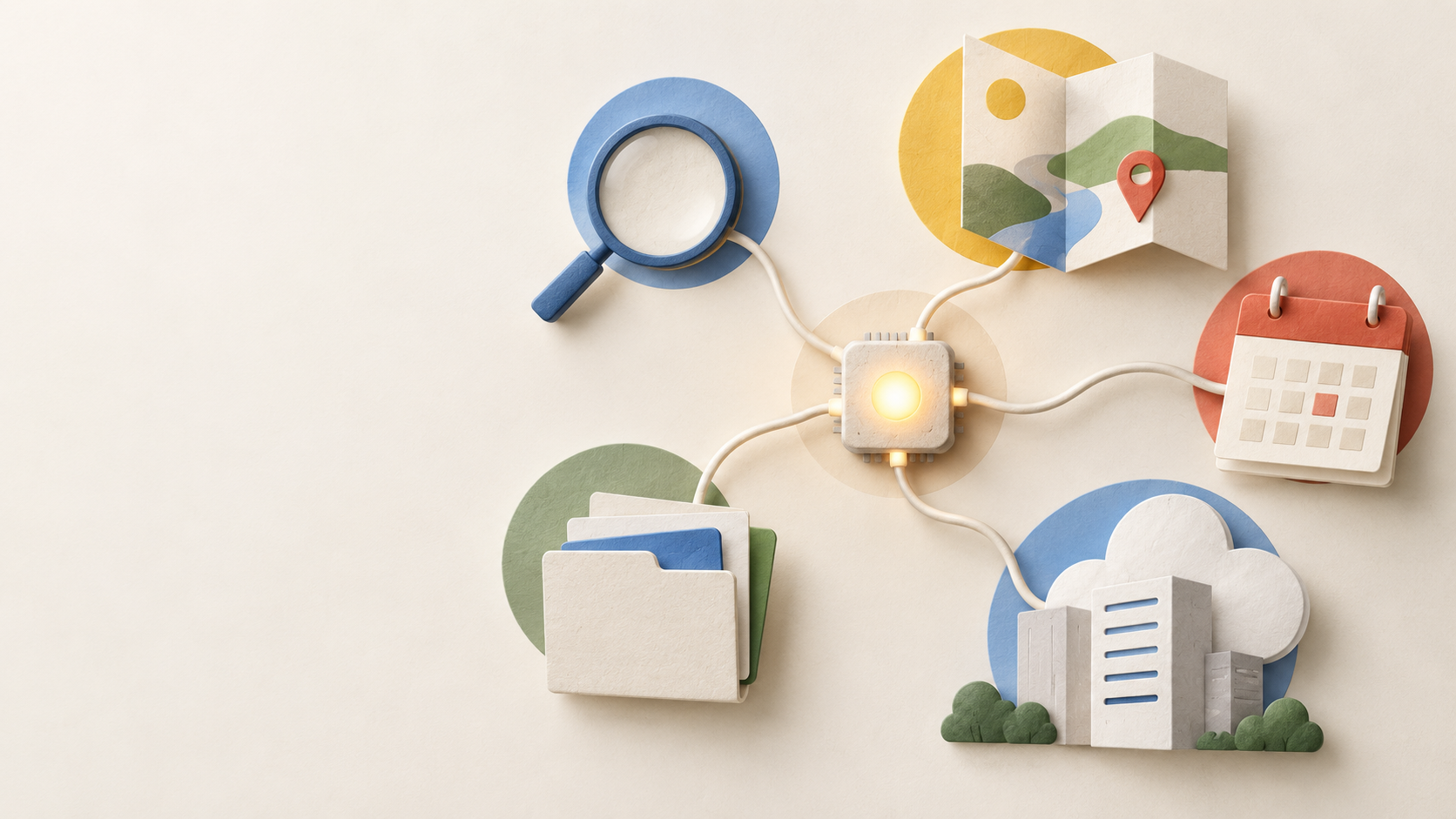
Google's recent AI research gives plenty of attention to usability and connected tools. That is a useful observation. It becomes misleading, however, if it is taken to mean Google is stepping away from frontier models.
On September 30, Google announced Gemini 4 Argon, a frontier model designed for complex, long-running work. Access currently begins with selected cyber defenders in the Fairwind program; this is not a broad public release. Frontier development and work on user experience are continuing together. Gemini 4 Argon announcement
Google's growth opportunity lies in connecting the two: putting capable models into services people already use, earning their repeat business, and turning that usage into cash flow. A better benchmark score, on its own, does not establish that this chain works.
What the papers reveal about practical AI
Three examples from Google Research and DeepMind illustrate problems that matter once people start delegating real tasks to AI.
| Research | Question it addresses | What it does not establish |
|---|---|---|
| ToolGrad · ACL 2026 | Can tool-use training data be built by constructing valid action sequences first? | Dataset and model experiments do not directly establish success rates in customer workflows. |
| Designing Proactive Thought Partners for Writing · September 2026 | How should writers configure an assistant's role and timing? | A formative study with 16 participants over one week cannot establish productivity gains at scale. |
| Agent-Initiated Interaction in Phone UI Automation · March 2025 | When should a phone agent ask a user, and how far should it act autonomously? | A task formulation and dataset are not evidence that a current product has solved the problem. |
These are consequential questions. An assistant that asks for confirmation at every step may create more work than it saves. One that makes important choices without permission may lose the user's trust. Adding tools helps only if the assistant carries the relevant context forward and leaves the user in control.
The papers are examples, not a census of Google's research portfolio. They cannot tell us the proportion of papers, funding or compute devoted to usability rather than frontier development. Google Research and DeepMind also cover different research areas. Treating a small selection as proof of a company-wide retreat would go beyond the evidence.
The product connection is becoming visible
A March Gemini API update allowed built-in tools such as Search and Maps to work alongside custom functions in one request, while preserving tool results for subsequent steps. It addresses the practical burden of connecting actions. The announcement does not independently establish lower latency or cost for every customer. Gemini API tooling update
In September, new Connected Apps began rolling out in Gemini, including Airtable, Linear, Adobe and Webflow. This extends the ambition beyond Google's own services into work users already do in other companies' products. Users must connect the apps, and a rollout announcement does not imply simultaneous availability for every account or region. Connected Apps announcement
For an investor, the important measure is how much effort disappears after the connection. Consider a hypothetical task: find information, compare options, then put the result into a team's work queue. The output from each stage must reach the next accurately, with less cleanup by a person. That is a possible workflow, not a claim that a particular product already guarantees the entire sequence.
Its competitors are pursuing tools, too
OpenAI introduced its Agents API in public beta in September, offering infrastructure to manage context, tools and long-running execution. Anthropic introduced interactive MCP Apps in January, bringing interfaces for tools such as Asana, Slack and Figma into Claude conversations. OpenAI Agents API, Claude interactive tools
All three companies want models to complete useful work. The existence of tool connections tells us little about who will win. The more revealing questions concern where a task begins, how easily an assistant acquires the right context, and whether a finished result earns another assignment.
MCP Apps is designed as an open extension usable by multiple AI products. That makes a connector catalogue a weak basis for claiming an exclusive advantage. Google's advantage must extend to the services people keep returning to, and the experience those services provide. MCP Apps' open design
Three possible paths to growth
The first is existing user habits. Search, Maps and work documents provide places where AI could fit into tasks people already perform. Less movement between services and less repeated data entry could encourage recurring use. Common ownership does not give an AI assistant unrestricted access to personal information, however. Permissions, privacy and local availability will shape the actual experience.
The second is monetization of search and work. If a user moves from an answer to comparison, selection and purchase, Google could earn revenue along that path. AI answers could also reduce existing ad clicks or raise the cost of serving a query. In workplace software, more time spent using AI is insufficient: customers need enough saved effort to justify paying and renewing. These are business interpretations, not profits demonstrated by feature announcements.
The third is enterprise infrastructure. Google Cloud provides a route to sell models alongside corporate data services and applications. Google's own TPUs also give it options for supplying compute and managing costs as demand grows. The economics of an in-house chip still need to be tested for each workload. Utilization, electricity, networking and repeated failed attempts all affect the cost of a completed job.
Google's August announcement positioned Gemini 3.7 Flash for coding and agents, with an introductory per-token price half the original 3.6 Flash price. It illustrates an effort to make useful capability more affordable. That is a launch-price comparison, not proof that the total cost of completing a workflow has fallen by half. Gemini 3.7 Flash announcement
The financial evidence cuts both ways
Alphabet reported Q2 2026 revenue of $119.796 billion, up 24%, and Google Cloud revenue of $24.768 billion, up 82%. Quarterly capital spending was $44.924 billion and free cash flow was negative $5.855 billion. Trailing twelve-month free cash flow remained positive at $53.273 billion. Alphabet Q2 earnings filing
Cloud includes AI solutions, infrastructure and existing cloud services; its growth cannot all be attributed to Gemini. Nor does a single quarter of cash outflow establish business deterioration. The question is whether growing demand eventually leaves more cash for shareholders. If infrastructure spending rises faster than cash generation, the reward from growth may arrive later.
Five developments to watch
| Measure | Evidence that strengthens the growth case | Evidence that weakens it |
|---|---|---|
| Repeat use by paying customers | Completed work leads to another assignment and renewal | Adoption remains concentrated in trials and occasional use |
| Cost per completed task | Cost falls after including human corrections and retries | Lower token prices are offset by expensive error handling |
| Search monetization | Profitability holds as AI usage expands | Advertising revenue declines while response costs rise |
| The composition of Cloud growth | Paid workflows and profits expand together | Infrastructure sales grow without durable workflow adoption |
| Cash remaining after investment | Utilization and cash recovery keep pace with spending | Investment and depreciation outrun the return on capacity |
Some of these measures are not disclosed precisely. Missing data cannot be used to declare the thesis proven. Product announcements and financial results can point in the same direction without closing every gap in the argument.
Google has both the ability to develop capable models and established routes to put them into everyday life and work. As capabilities become more comparable, distribution and operating costs could matter more. But if a competitor earns users' trust and becomes their preferred starting point, Google's existing scale may fail to translate into incremental growth.
My business assessment is conditionally positive. Google owns several businesses that could capture demand as AI becomes more widely used. The evidence to look for is durable search profitability, enterprise renewals and cash recovered after infrastructure investment. This article examines those business pathways; it does not calculate fair value at the current share price. A promising business and an attractive purchase price require separate judgments.
Research as of October 7, 2026. Observations from papers and product announcements are distinguished from business interpretations.
Related reading: Where AI Investment Pays Back · AI Power and Data-Center Bottlenecks