The Day Tesla Turns On Robotaxi: When the Car Becomes an AI Platform
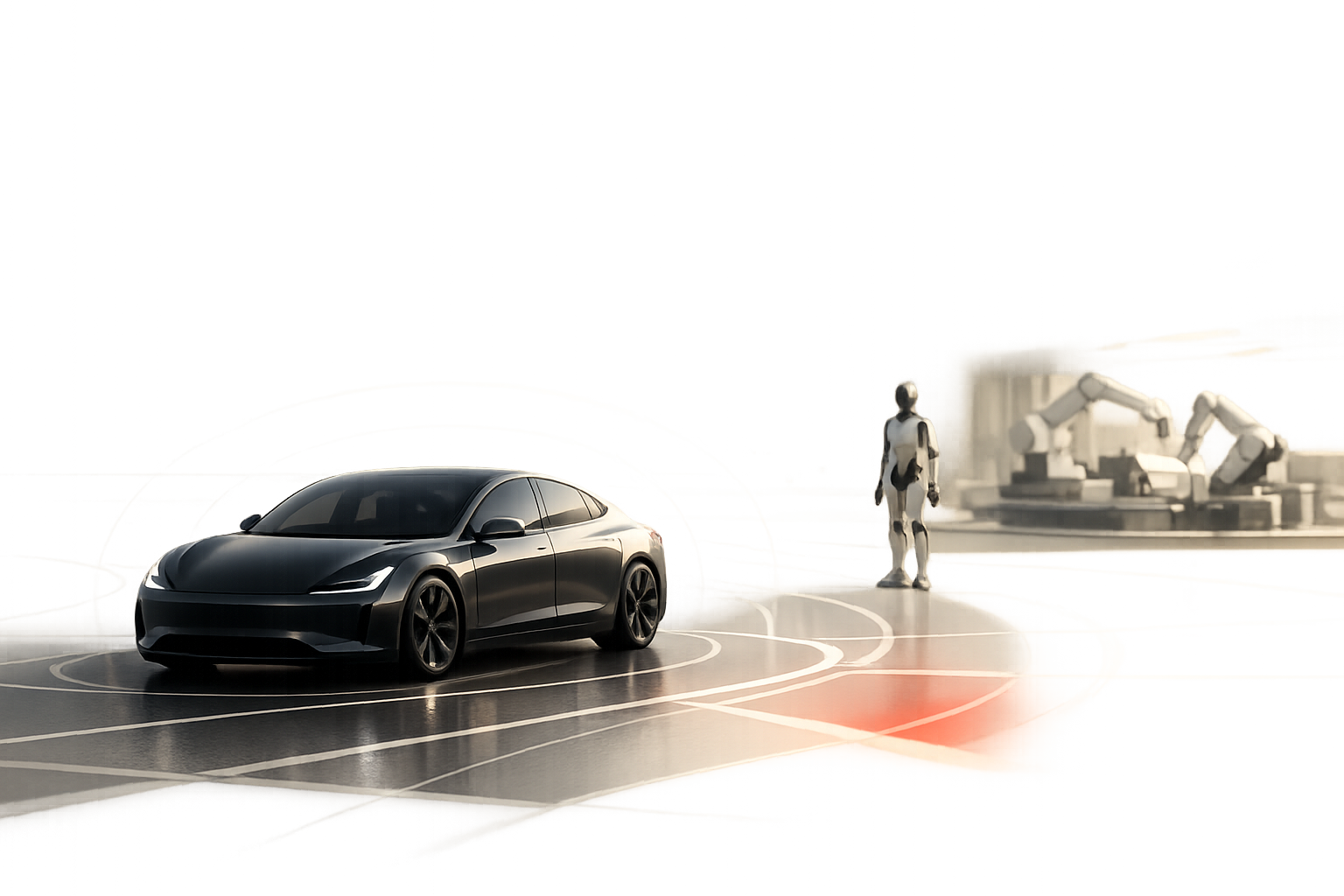
Cern Basher’s long-form discussion is not really about one more mobility app. It frames Robotaxi as a broader platform shift: cars update like software, AI begins to drive, robots learn the physical world, and infrastructure may expand beyond the car itself.
Start with the conclusion
The video’s strongest idea is simple: Tesla should not be read only as a car company if Robotaxi, Cybercab, FSD, Optimus, and AI interfaces all move in the same direction. The possible transition is from vehicle sales to a physical-AI platform.
Robotaxi and Optimus connect autonomy, robotics, and real-world AI.
Strong narratives can be priced before the operating numbers arrive.
A powerful platform story is not the same as a good entry point.
This article uses the video as a prompt, not as final evidence. Claims about SpaceX orbital compute, Tesla AI phones, or near-term Cybercab production are treated as forecasts or opinions unless supported by public company material.
1. Robotaxi is a network question, not only a car question
The video frames Robotaxi as a shift from one-time vehicle sales to a continuously improving network asset. A car that receives software updates, drives autonomously, and generates service revenue is economically different from a car that is sold and depreciates in private ownership.
Traditional auto economics.
The car changes after delivery.
Driving behavior becomes a model problem.
The car can become a revenue-producing asset.
Road and robotics data become part of real-world AI learning.
Tesla’s Q1 2026 update says the company continued building AI software and infrastructure for Robotaxi and future robotics businesses, and prepared lines for Cybercab, Tesla Semi, and Megapack 3. That does not prove the full bull case, but it confirms the direction of management focus.
2. Cybercab is a manufacturing and unit-economics question
The speakers argue that Cybercab could be structurally easier to build than a traditional vehicle. The investment question, however, is not whether the concept sounds simpler. It is whether production volume, cost, safety, regulation, utilization, and insurance can work together.
| Checkpoint | Why it matters | Positive evidence | Negative evidence |
|---|---|---|---|
| Cybercab production | The story must meet factory reality. | Quarterly production disclosure, cost improvement | Delays or pilot-only deployment |
| Paid Robotaxi miles | Service revenue must become visible. | More cities, higher utilization, stable safety metrics | Regulatory limits, accidents, low demand |
| Liability and insurance | Unsupervised mobility is also a legal product. | Clear operating approvals | Restrictions or rising insurance cost |
| Economics per vehicle | The network needs attractive unit economics. | High utilization and low maintenance cost | High remote-support, repair, or depreciation cost |
3. From apps to AI agents
The middle of the video moves into Cursor, vibe coding, AI phones, and the possible weakening of app-store logic. The idea is that users will increasingly ask AI for outcomes rather than open separate apps and search for fixed buttons.
That matters for cars because the vehicle interface can also move from fixed menus to conversational control. In that world, Tesla’s advantage would not only be the screen. It would be the integration of hardware, data, autonomy, and software updates.
4. Optimus is the public shock layer of physical AI
Robotaxi would surprise people on the road. Optimus could surprise them in stores, factories, and homes. The broader thesis is that physical-world AI needs more than internet text. It needs motion, grasping, spatial judgment, feedback, and real-world exception handling.
That is why vehicles, robots, cameras, wearables, and simulation may become connected learning systems. For investors, Optimus remains a long-duration option until revenue, cost, and margin are visible.
5. Space-based compute is interesting, but still a hypothesis
The video’s most speculative layer is the SpaceX and orbital-compute discussion. Lower launch cost and Starlink connectivity make the idea worth watching, but space-based data centers still face power, cooling, maintenance, latency, regulation, and cost constraints.
So the right framing is not “this is already an investable fact.” It is a long-duration hypothesis about where AI infrastructure bottlenecks might move if launch cost keeps falling.
6. Trust becomes a strategic asset
The discussion also compares Apple, Google, and Meta. Google has data. Apple has trust and hardware discipline. Meta has distribution and eyewear partners, but the speakers question whether users feel good enough about the brand to give it deeper personal access.
That point applies to Robotaxi as well. A driverless mobility service handles location, payment, safety, and behavioral data. In an agentic-AI world, trust is not a soft marketing asset. It becomes part of the product.
7. Growth × Liquidity reading
- Robotaxi could shift Tesla from vehicle sales toward network economics.
- Cybercab could change cost and utilization assumptions.
- FSD and Optimus sit inside the same physical-AI direction.
- AI interfaces may increase the value of integrated hardware/software ecosystems.
- Unsupervised autonomy needs regulation, safety, and liability clarity.
- Cybercab volume and cost still need evidence.
- Optimus and orbital compute remain long-duration options.
- A strong narrative can be priced before cash flow arrives.
The better investment conclusion is not “buy because Robotaxi is exciting.” It is: Tesla may deserve to be analyzed as a physical-AI platform, but the company case, valuation, and timing must be separated.
Investor checklist
| Question | Evidence to watch | Interpretation |
|---|---|---|
| Does Robotaxi become a real service? | Cities, paid miles, safety metrics, approvals | First validation of the platform story. |
| Can Cybercab scale? | Production, cost, utilization | Core proof for network economics. |
| Does FSD move beyond supervised use? | Regional approval, liability framework, safety data | The gate from car software to mobility platform. |
| Does Optimus become revenue? | Factory deployment, external customers, unit economics | Long-term validation of physical AI. |
| Does liquidity support high-duration growth? | Rates, VIX, breadth, AI-basket flows | Even a strong company can suffer when liquidity weakens. |