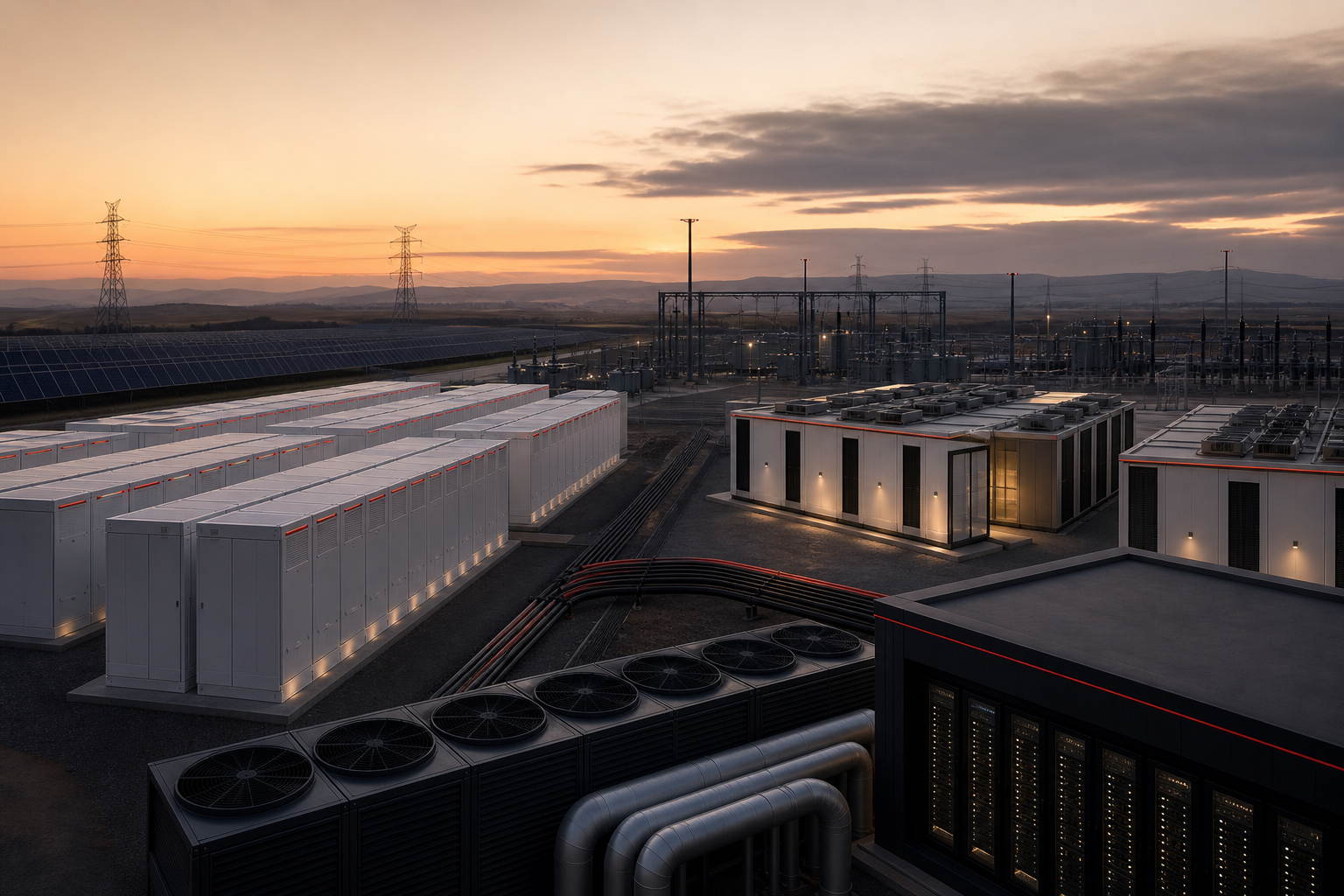
Tesla Megapod: The AI Cloud Bottleneck Is Power
Tesla’s reported MEGAPOD trademark and the growing discussion around Megapack for AI data centers point to a larger shift. The important question is not whether Tesla instantly becomes a cloud provider. It is whether AI cloud competition is moving from GPU procurement into power, cooling, storage, and modular deployment capacity.
Start with the conclusion: Megapod is less about a name and more about AI’s power bottleneck
Tesla MEGAPOD is still an early signal visible through trademark and media reporting, not a launched product. But the signal matters because AI data-center competitiveness is no longer explained by GPUs alone. Power buffering, cooling, modular installation, and infrastructure execution are becoming part of the AI cloud stack.
The right interpretation is not “Tesla replaces NVIDIA.” It is: if AI clouds become constrained by power, Tesla Energy, battery storage, power electronics, and modular data-center packaging could become more strategically relevant.
What the MEGAPOD filing says, and what it does not say
Electrek reported that Tesla filed a MEGAPOD trademark covering modular data-center hardware systems for AI computing, including servers, AI data-processing hardware, networking equipment, power distribution units, cooling systems, and related management software.
That is a meaningful signal. It suggests Tesla is at least reserving room to think beyond batteries and into a physical AI-compute package. But a trademark filing is not a launch, revenue stream, or customer contract. At this stage, investors should separate the option value from confirmed operating evidence.
The chart’s direction is useful, but its certainty should be lowered
The direction is important: AI cloud bottlenecks are moving into power, deployment, and capex. But claims such as fully off-grid AI clouds, Supercharger-site conversion, or direct AI5/AI6 integration should be treated as scenarios until Tesla confirms them.
The AI cloud stack is expanding beyond chips
GPU, ASIC, HBM
The starting point of AI performance, but not the whole product.
Grid, BESS, PPAs
The real ceiling on usable compute capacity.
Cooling and density
Determines reliability and operating cost.
Modular sites
Turns demand into usable capacity quickly.
Operations
Optimizes power, cooling, and compute together.
Capex and leases
Separates productive growth from overbuild.
Long contracts
Converts infrastructure into visible cash flow.
Grid approval
The slowest layer can set the whole speed limit.
AI data centers do not only consume power; they swing it rapidly
Large AI training clusters can move from heavy load to lower load very quickly during checkpointing, communication waits, or job transitions. SemiAnalysis highlighted why this load profile creates power-quality challenges for grids that must balance generation and consumption in fractions of a second.
This is where Megapack-type battery storage becomes more than backup power. It can act as a buffer between the grid and the AI cluster, absorbing or supplying energy as the workload changes. The investment question is whether that buffer becomes standard infrastructure for large AI campuses.
Tesla’s more realistic edge is power infrastructure, not replacing the GPU stack
The center of AI compute silicon remains the NVIDIA ecosystem today. MEGAPOD should not be read as proof that Tesla is about to replace the server stack. Tesla’s more credible angle is Megapack, power electronics, energy software, battery manufacturing, and field deployment experience.
That makes the story more about AI power infrastructure and modular packaging than about AI chips alone. If AI cloud growth keeps stressing power availability and load stability, the value of Tesla Energy’s infrastructure layer could rise.
Growth: AI demand raises the value of the power layer
AI models, agents, and inference services require larger clusters and more reliable compute. If that demand continues, the bottleneck moves deeper into the physical world. Power, substations, battery storage, cooling, and construction determine how fast purchased chips become revenue-producing capacity.
MEGAPOD matters if it becomes evidence that Tesla can productize part of that power-aware AI infrastructure layer.
Liquidity: the power layer is asset-heavy
A strong narrative is not the same as a good entry point. AI power infrastructure requires large capex, long payback periods, debt or lease financing, power contracts, and local approvals. If rates stay high or AI monetization slows, the same infrastructure can become a burden.
Investors should separate the company’s strategic option from the stock’s current price and timing.
The checklist is simple
Does MEGAPOD become a product, pilot, customer deployment, or disclosed offering?
Can Megapack solve AI data-center power-quality problems at attractive cost?
Are Supercharger or solar-plus-storage sites actually used for compute, or is that only a scenario?
When the thesis strengthens
- MEGAPOD moves from filing to product or pilot.
- AI data centers repeatedly adopt BESS for load fluctuation and power quality.
- Tesla Energy backlog and margins improve from data-center demand.
- Energy software turns hardware deployment into recurring operational value.
- AI capex generates enough cash flow to tolerate financing cost.
When the thesis weakens
- MEGAPOD remains only a trademark signal.
- Alternative power-quality solutions prove cheaper or faster.
- Megapack demand grows but margins, cost, or installation speed disappoint.
- AI cloud capex is repriced as overbuild rather than productive growth.
- Grid regulation and local opposition slow deployment.
Investment view: Megapod is a power-bottleneck story before it is a cloud story
The overhyped version says Tesla is about to build fully off-grid AI clouds. Public evidence does not support that level of certainty yet. The more useful interpretation is that AI cloud competition is expanding from GPUs into power, cooling, and modular infrastructure, and Tesla may be trying to reserve a role in that layer.
AI growth remains strong, but the bottleneck is increasingly physical. The next phase will not be decided only by who has the best model or the most GPUs. It will also be decided by who can secure power, stabilize load, cool dense clusters, install capacity quickly, and finance the build-out. MEGAPOD is a Tesla-shaped signal inside that larger question.
Korean version: Read the Korean version
Source-use standard: this article is a market interpretation based on public trademark, media, and product material. A trademark filing does not guarantee launch or revenue, and this is not a buy or sell recommendation.
Telegram: https://t.me/signalandflow
Public sources checked
MEGAPOD is an early signal visible through trademark and media reporting. Product launch, pricing, customers, Supercharger use, and off-grid configuration still require separate confirmation.