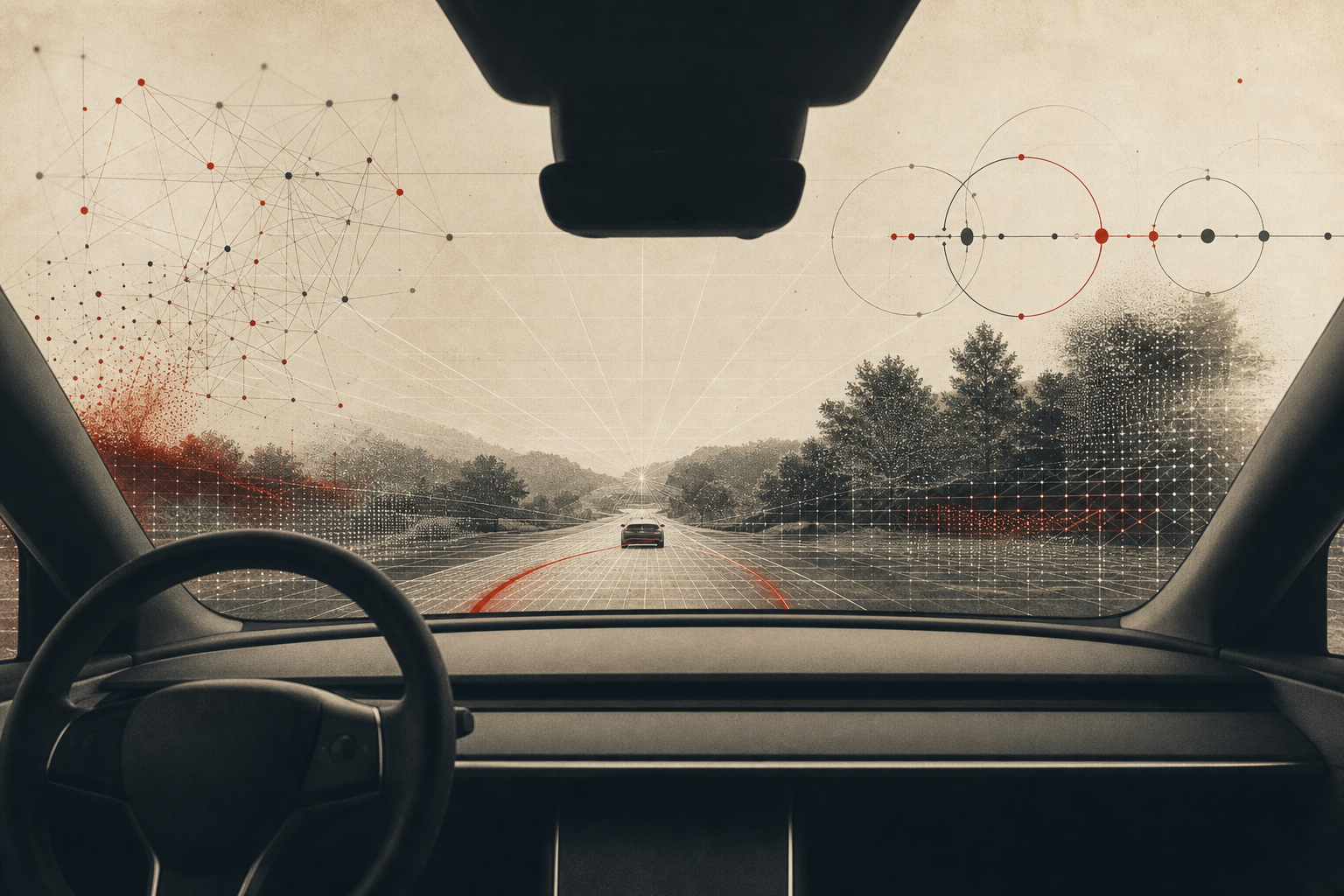
Tesla’s AI Science: What FSD Shows About Vision-to-Control Intelligence
The technical meaning of Tesla FSD is not merely that a car can drive itself. It is that a neural system is turning high-dimensional vision into long-horizon closed-loop control in the real world.
Core thesis: The AI-science meaning of FSD is not simply driving automation. It is the integration of visual representation, prediction, behavior policy, and closed-loop physical control.
From pixels to steering
Road geometry, actors, lanes, and drivable space.
How surrounding actors may move over the next seconds.
Safe and natural trajectories where there is no single label.
Actions change the world and create the next input.
Bottom line
The scientific importance of Tesla FSD is not simply that a car can appear to drive itself. The deeper point is that FSD is a neural system attempting to turn high-dimensional visual input into long-horizon closed-loop control. Pixels are not steering commands. Between the camera and the steering wheel sit spatial representation, temporal prediction, multi-agent interaction, intent inference, risk assessment, trajectory choice, and control stability.
That is why FSD should not be read only as a driver-assistance feature. From an AI-science perspective, it is a rare product-scale experiment where a vision model, behavior policy, control system, fleet learning loop, and embodied deployment environment meet in one system.
This does not mean Tesla has completed unsupervised autonomy. Tesla’s product is officially Full Self-Driving (Supervised) and requires active driver supervision. The point is the technological direction: FSD is one of the clearest public examples of AI leaving benchmark tasks and entering a physical world where actions carry real consequences.
Why driving is harder than a normal AI benchmark
Image classification labels a picture. Language models predict tokens from context. Both are difficult, but the input-output boundary is relatively clear. Driving is different. A driving system must operate in a partially observed world where vehicles, pedestrians, and human drivers act with different hidden intentions.
Lane markings can disappear. Pedestrians can hesitate. Cars can merge without signaling. Construction zones can contradict the map. Intersections require not only rules but implicit negotiation. The scene changes continuously over time.
So the FSD problem is not “recognize a traffic sign.” It is a multi-agent prediction-and-control problem: infer what is happening, predict what might happen next, and choose a safe action in real time.
Shortening the distance from vision to control
Traditional autonomy stacks often separate perception, mapping, object tracking, planning, and control. That makes debugging easier. But as the world becomes more complex, the boundaries between modules can become brittle. A perception module may identify a vehicle correctly while the planner fails to represent its intent. A planned path may be mathematically valid but behaviorally unnatural.
Tesla’s direction reduces that distance. Camera and video inputs are compressed into representations that are useful for action: road geometry, objects, occupancy, actor motion, drivable space, and candidate trajectories. In AI terms, the separation between perception and policy becomes weaker.
Humans do not drive by first converting the world into a complete symbolic rule list. We see a scene and immediately form action-relevant judgments: that car may merge, that pedestrian may cross, this moment calls for braking. FSD is interesting because a similar form of visuomotor intelligence is appearing inside a large-scale neural system.
Learning behavior when there is no single right answer
Driving rarely has one correct label. At the same intersection, stopping, creeping forward, or proceeding can all be reasonable depending on the state of surrounding actors. What matters is how the current action changes the next few seconds of the world.
That makes FSD a long-horizon closed-loop policy problem. A slightly delayed brake changes the reaction of the car behind. A slightly different lane position changes a merge two seconds later. The action changes the world, and the changed world becomes the next input.
This is physically stricter than next-token prediction. A wrong token can make a sentence awkward. A wrong control decision can create risk. That is why uncertainty, conservatism, failure detection, and supervision matter as much as raw capability.
The long-tail problem
The easy 95% of driving can improve quickly. Clear lanes, normal traffic, and good weather are not the full problem. The hard part is the remaining 5%, or even 0.1%: unusual construction zones, pedestrians emerging between parked cars, motorcycles splitting lanes, mismatches between maps and roads, or conflicting traffic signals and human gestures.
A rule-based system must keep adding exceptions. The more exceptions it adds, the more fragile the system becomes. FSD’s technical ambition is to absorb more of that long tail through large-scale real driving data and a fleet feedback loop.
If this works, the implication goes beyond cars. One of the hardest problems in real-world AI is learning rare but important exceptions and validating behavior under those exceptions. FSD is attacking that problem in public roads, one of the most complex environments available.
Multi-agent intent inference
Roads are not just physical spaces. They are social spaces. Vehicles and pedestrians are objects, but they are also actors with intentions. Whether a car will merge, whether a pedestrian will cross, whether a stopped car is parked or waiting, and whether another driver will yield cannot be solved by object detection alone.
This is intent inference. Human social behavior often moves through subtle signals rather than explicit rules: vehicle angle, slight deceleration, gaze, pace, hesitation. If FSD increasingly handles those patterns, it suggests that AI is learning statistical structure in real-world social dynamics.
FSD as embodied AI
Many AI systems live on screens. They generate text, images, or code. FSD is connected to the physical world. Inputs come from photons, cameras, noise, weather, reflections, and road conditions. Outputs become steering, acceleration, and braking.
That is embodied intelligence. The agent observes the world, acts, observes the result, and replans. NVIDIA’s CES 2025 framing of physical AI as systems that can perceive, reason, plan, and act fits this loop. FSD runs that loop inside a car.
The hard part after capability is verification
A neural control system becomes more difficult to govern as it becomes more capable. Where does it fail? Does it over-trust itself out of distribution? Can failure be detected before it matters? How should uncertainty be represented? How do updates get validated before reaching public roads?
Tesla’s advantage, if it exists, is not just the model. It is the system around the model: data collection, edge-case mining, simulation and replay, evaluation, driver supervision, OTA deployment, and fleet learning. In the same way that agentic language models require evaluations and control layers, physical AI requires a control and verification operating system.
The AI-science view of Tesla’s technical power
Reading Tesla only as an EV manufacturer underestimates the FSD question. FSD requires four technical layers at once.
| Technical axis | Meaning in FSD | Why it is hard |
|---|---|---|
| Visual representation | Compress video into road, objects, and spatial structure | Weather, reflections, occlusions, damaged lanes, and regional variation |
| Temporal prediction | Predict how surrounding actors may move | Human intention is uncertain and interactive |
| Behavior policy | Choose safe and natural trajectories | There is no single correct label and long-term effects matter |
| Closed-loop control | Act in the world and observe the new state | Small control differences can change future states materially |
When these layers combine, FSD becomes a real-world AI system rather than a simple feature. It also becomes a possible precursor to broader robotics. Roads are structured, but they are still complex, risky, and full of exceptions. If AI can learn stable vision-action policies there, similar principles may extend to logistics robots, drones, industrial automation, humanoids, and home robots.
Investment interpretation
In Growth × Liquidity terms, the growth axis is clear. If FSD can extend into Robotaxi, subscription, licensing, and Optimus, Tesla may be redefined from an EV manufacturer into a physical-world AI platform with real-world behavioral data.
The liquidity and valuation axis is more demanding. Markets can price possibility early, but high expectations require faster verification. Unsupervised autonomy, regulatory approval, geographic expansion, real Robotaxi operations, intervention-rate improvement, unit economics, and liability structure must eventually turn into cash flow.
So Tesla should be separated into company, price, and timing. The company thesis is strong if FSD is truly a training ground for Physical AI. The price thesis depends on how much of that future is already reflected. The timing thesis depends not on impressive demos alone, but on regulatory and commercial evidence.
Final note
The greatness of FSD is more technical than the sentence “a car drives itself.” A more precise formulation is this:
FSD is a large-scale neural system that learns spatial and temporal structure from visual input, predicts implicit human behavior in a multi-agent environment, and converts those predictions into real-time physical control.
Vision is hard. Time is hard. Multi-agent interaction is hard. Human intent inference is hard. Control is hard. Safety validation is hard. FSD matters because it pushes all of these problems inside one working system.
It may not be the final answer yet. But from an AI-science perspective, it is a powerful signal of where real-world AI is heading. If language models are changing intelligence in software, FSD is showing how behavioral intelligence may emerge in the physical world.
Public sources checked
This article uses Tesla’s Full Self-Driving (Supervised) and AI & Robotics pages, plus NVIDIA’s CES 2025 public description of physical AI, as source anchors. Tesla pages restricted automated direct extraction, so official URLs are provided as source links and claims are kept within the public product boundary.
Korean version: Read the Korean version