SpaceX–Tesla Merger Talk: What the IPO Changes for Shareholders
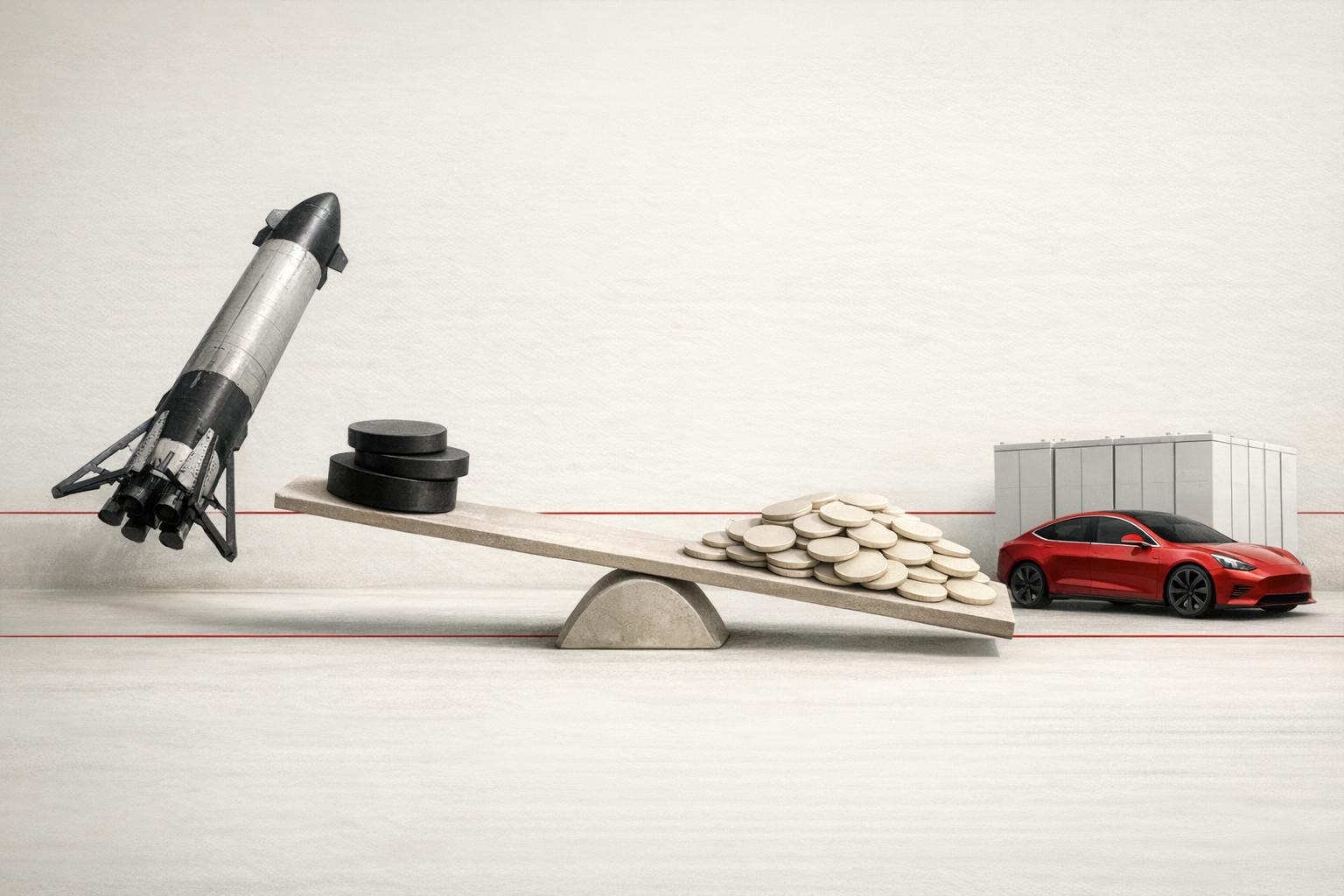
SpaceX has completed its IPO and its industrial ties with Tesla are deepening. Yet as of August 13, 2026, there is no merger agreement, board-approved exchange ratio, S-4, or merger proxy. The more important question is the value Tesla’s Robotaxi, Cybercab, and Semi businesses and SpaceX’s AI-compute and Starlink businesses can prove independently over the next two years. This article compares a merger now, a 2028 repricing, and cooperation without a merger from both shareholder perspectives.
As of August 13, 2026 · Prices use the August 12 U.S. close · All amounts in U.S. dollars
Tesla’s Robotaxi, Cybercab, and Semi businesses and SpaceX’s AI-compute and Starlink businesses could each remove major uncertainty over the next two years. Fixing ownership today would make the faster winner share its standalone upside with the other side. The better current structure is business cooperation now and an equity repricing in 2028.
What is confirmed, and what is still missing
| Bucket | Confirmed position | Investor meaning |
|---|---|---|
| Official | SpaceX completed its June 2026 IPO and trades on Nasdaq as SPCX. The IPO price was $135. |
A public market price now exists for exchange-ratio analysis. |
| Official | SpaceX Class A carries one vote per share; Class B carries ten. The prospectus put Musk at 82.4% voting power after the offering. | Economic ownership and control are radically different. |
| Official | Tesla invested $2.002 billion in SpaceX in the first half. Tesla recognized $318 million of Q2 and $405 million of first-half revenue from SpaceX. | The companies are already linked through capital and commerce. |
| Official | SpaceX bought $295 million of Tesla Megapacks in Q2 and $329 million in the first half. | The AI-compute and energy-storage link is showing up in reported numbers. |
| Major reporting | Reuters reported in July that Musk cited growing overlap while saying any transaction would require a proper process. In August, Reuters reported a $16.8 billion initial Terafab investment in Texas. | Strategic overlap is real, but statements and projects are not a merger agreement. |
| Still absent | Merger agreement, exchange ratio, independent special committee recommendation, fairness opinion, shareholder meeting, S-4, or merger proxy. | Until these appear, “deal certainty” is a trading narrative, not a fact. |
Part of the May thesis has become fact
In May, the case rested on a hypothetical SpaceX listing. The listing is now complete, giving SpaceX a quoted price. Tesla owns SpaceX stock, the companies buy and sell products to each other, and both are pursuing a large semiconductor project.
Their operations overlap more as well. SpaceX now includes rockets, Starlink, xAI, AI compute, and data centers. Tesla is moving beyond vehicles into robotaxis, Optimus, energy storage, and semiconductors. That creates a plausible platform spanning satellite communications, power, chips, robotics, and physical AI.
The industrial logic is stronger than it was in May. Whether a merger would offer fair terms to Tesla shareholders is a separate question.
How the picture differs from May
- SPCX now has a market price and trading history.
- At the latest prices, SpaceX is worth roughly $1.93 trillion, compared with about $1.29 trillion for Tesla.
- Tesla’s SpaceX investment, Megapack revenue, and Terafab are now part of the public record.
No transaction structure has been disclosed. Musk also rejected the report that Tesla planned to sell its China business, so a China separation cannot be treated as an established step toward a merger.
The growth story is powerful, but so is the capital bill
| Axis | SpaceX | Tesla | Merger reading |
|---|---|---|---|
| Growth | Q2 revenue $7.814B, up 91.9% year over year | Q2 revenue $28.236B, up 25.5% | Cross-selling and shared space, communications, AI, robotics, and energy infrastructure could expand. |
| Profitability | Q2 operating loss $143M | Q2 operating income $398M, down 56.9% | Revenue growth alone does not justify a deal premium; both need better margin evidence. |
| Cash flow | H1 operating cash $3.466B; capex $28.476B | H1 operating cash $8.634B; capex $8.282B | Simple free cash flow was roughly negative $25.01B for SpaceX and positive $352M for Tesla. |
| Liquidity | $93.522B of cash at June 30, reinforced by IPO proceeds | $43.52B of cash and short-term investments | Neither is immediately cash-starved, but AI, chips, and space infrastructure remain extraordinarily capital intensive. |
For comparability, simple free cash flow here is operating cash flow minus property and equipment purchases. It may differ from company-defined adjusted measures.
Market values expose the voting gap
Applying the Aug. 12 closes to the latest share counts gives SpaceX a simplified equity value of about $1.93 trillion and Tesla about $1.29 trillion. Together they total approximately $3.22 trillion. The figures are reference points; an actual transaction would reflect its own premium and terms.
The table below illustrates a SpaceX acquisition of Tesla paid entirely with newly issued SpaceX Class A shares. No such proposal has been announced.
| Assumed Tesla premium | SPCX per TSLA share | Tesla holders’ post-deal economics | New Class A share of total votes | Existing Class B share of votes |
|---|---|---|---|---|
| 0% | 2.241 | 40.2% | 12.4% | 76.8% |
| 10% | 2.465 | 42.5% | 13.5% | 75.9% |
| 20% | 2.689 | 44.6% | 14.5% | 75.0% |
Under this simple structure, Tesla holders would own 40% to 45% of the combined economics but control only 12% to 15% of the vote. Newly issued Class A shares carry one vote apiece, while existing Class B shares carry ten. Economic ownership close to one-half could therefore come with far less influence over company decisions.
The voting illustration assumes all Tesla consideration is new one-vote SpaceX Class A and existing Class B remains ten-vote stock. Actual results would depend on deal terms, conversions, new issuance, employee awards, and regulatory conditions. The Class B percentage refers to all Class B votes, not Musk’s personal voting power.
The winner depends on the terms, not the direction of the arrow
Premium, voting rights, and responsibility for future capital spending can change the outcome. These are sensitivity cases based on the Aug. 12 closes and the latest reported share counts, not proposed terms.
| Outcome | Terms | Existing Tesla holders | Existing SpaceX holders | Decision test |
|---|---|---|---|---|
| Tesla holders have the better terms | SpaceX pays roughly a 20% Tesla premium, brings voting power closer to economic ownership, and does not automatically fund future SpaceX or xAI needs with Tesla cash. | They receive 44.6% of the combined economics plus stronger governance protection. | Their economic stake falls to 55.4%, and super-voting control is partly surrendered. | The premium is borne by SpaceX holders, making an independent committee and disinterested shareholder approval essential. |
| SpaceX holders have the better terms | Tesla buys SpaceX at a 10% premium and pays in Tesla common stock. SpaceX holders receive a high relative valuation and liquid Tesla shares. | Their economic stake falls to 37.9%, while SpaceX capex and xAI funding needs enter the same balance sheet. | They own 62.1% of the combined economics. If Tesla common remains one-share, one-vote, the gap between ownership and voting power is also narrower than under SpaceX Class B. | A 10% SpaceX premium costs about $192.7B. Tesla holders need evidence that the combination can earn it back. |
| Both sides gain | SpaceX pays a 10% Tesla premium, but Class B is sunset or adjusted, capital allocation is independent, and part of the consideration can depend on verified synergies. | They receive 42.5% of the economics and about $129.4B of premium, with voting power closer to that stake. | They accept dilution but avoid a loss if the combined company creates more value than the premium paid. | The combined value must rise at least 4.0% above the simple sum for existing SpaceX holders to break even. Gains for both groups begin above that level. |
| Both sides lose | The buyer pays a high premium, Class B stays intact, and regulatory, integration, AI, and space-infrastructure costs rise. | A headline premium can disappear if the combined stock trades below the deal value. Weak voting rights would add another discount. | They absorb dilution and the premium without recovering it through synergy. | A 20% Tesla premium requires value creation equal to about 8.0% of the current combined value. A larger integration discount can leave both groups worse off. |
| Cooperation without a merger | Megapack, Starlink, AI compute, and Terafab stay under long-term contracts or joint ventures, with independent pricing and funding terms. | They avoid dilution and SpaceX’s super-voting structure, while Tesla cash flow remains visible. | They can use Tesla’s manufacturing and energy capabilities without giving up SpaceX’s capital and governance choices. | If contracts capture most of the synergy, this may be the better outcome for both ordinary shareholder groups. |
The combined company has to earn back what one side receives
In an all-stock transaction, the target premium is dilution for the buyer’s existing holders. Both groups avoid a loss only if incremental value at least covers that premium.
| Assumption | Premium | Target holders’ economics | Existing buyer economics | Minimum combined value | Required uplift from current sum |
|---|---|---|---|---|---|
| SpaceX → Tesla 2.465 SPCX per TSLA |
10% · $129.4B | Tesla 42.5% | SpaceX 57.5% | $3.35T | +4.0% |
| SpaceX → Tesla 2.689 SPCX per TSLA |
20% · $258.7B | Tesla 44.6% | SpaceX 55.4% | $3.48T | +8.0% |
| Tesla → SpaceX 0.491 TSLA per SPCX |
10% · $192.7B | SpaceX 62.1% | Tesla 37.9% | $3.41T | +6.0% |
| Tesla → SpaceX 0.535 TSLA per SPCX |
20% · $385.3B | SpaceX 64.1% | Tesla 35.9% | $3.61T | +12.0% |
The illustration assumes an all-stock exchange with no cash or debt adjustment, uses the latest reported shares outstanding and Aug. 12 closes, and excludes fully diluted shares, options, awards, taxes, and transaction costs. “Minimum combined value” is the break-even level at which the buyer’s existing holders are not diluted in value by the premium. It is not a forecast of synergy timing or present value.
Which side gives away more of its future by merging now?
Both companies could remove a large amount of business uncertainty over the next two years. Fixing an exchange ratio today would make the faster-growing company share much of its standalone upside with the other side. For both shareholder groups, the right to wait two years has value.
| Path through 2028 | Tesla holders | SpaceX holders | Stronger structure |
|---|---|---|---|
| Tesla inflects first Robotaxi economics and Cybercab scale are proven, with Semi and energy following. |
A merger today can transfer standalone upside at a low exchange ratio. | Owning Tesla before the evidence arrives can be attractive. | Tesla remains separate or receives a large option premium |
| SpaceX AI inflects first Compute utilization, customers and margins improve while Starlink cash flow and orbital tests advance. |
Joining SpaceX upside today may be attractive. | There is less reason to give roughly 40% of future upside to legacy Tesla holders. | SpaceX remains separate or uses AI/orbital tracking stock |
| Both succeed | Each side wants to preserve its own upside. | Each side wants to preserve its own upside. | Contracts and JVs, then a 2028 repricing |
| Both are delayed | A merger can hide execution failure. | Both capex burdens and losses enter one ledger. | Reset investment priorities rather than merge |
Robotaxi economics matter more than fleet announcements
Tesla is expanding the Robotaxi service it launched in June 2025 and began Cybercab production in the first half of 2026. It is also building cleaning, maintenance, charging, security, tele-assistance, and fleet-management infrastructure. The service is moving, but the operating data needed to value it remain limited.
Contribution per mile has to cover depreciation, insurance and accident costs, tires, cleaning, maintenance, tele-assistance, charging infrastructure, and empty miles. Strong numbers could move Tesla from one-time vehicle sales toward recurring transport revenue. Weak insurance and support economics could instead make Robotaxi more capital intensive than the existing vehicle business.
Cybercab is the dedicated asset that can change those unit economics. The next two years should be judged on output, manufacturing cost, paid utilization, empty miles, insurance, and maintenance rather than launch imagery. If those figures work, Tesla enters any later negotiation with more leverage.
Tesla still owns options beyond Robotaxi
Semi can extend beyond truck sales into commercial batteries, Megachargers, fleet software, logistics data, autonomous freight, and storage for distribution centers. Current filings establish public Megacharger deployment and production preparation, but not scaled output, customer economics, or per-unit margin.
Tesla deployed 22.3 GWh of energy storage in the first half of 2026, and Megapack sales to SpaceX are already reported revenue. That shows Tesla can serve AI-data-center power needs through contracts without a merger. Optimus is a longer-dated option: production deployments, useful work hours, and cost savings should precede any large upfront transaction value.
1.4 GW is real capacity, but utilization and returns remain unproven
SpaceX reported 1.4 GW of nameplate AI compute capacity at the end of Q2 2026, up from 0.4 GW a year earlier. The company also says the measure is not actual power consumption or utilization. Q2 AI revenue was $2.561B, the segment lost $1.257B from operations, and first-half AI capex was $23.551B.
Ground compute assets and cloud contracts are verified value. Sustained utilization, customer retention, cost per token, and long-run margin are still being tested. Terafab at scale and orbital AI compute are options rather than current earnings.
SpaceX does not need Tesla cash simply to keep operating
Starlink reached 12.0 million subscribers in Q2 2026, double the prior year. Monthly revenue per subscriber fell from $85 to $66, but Connectivity revenue reached $4.291B and operating income reached $1.656B. That is an operating margin of about 38.6%. SpaceX also held $93.522B of cash at quarter-end.
Orbital AI compute is the longer option. SpaceX says orbital data-center satellites could begin deployment as early as 2028. Reusable launch, mass-produced satellites, Starlink laser links, solar power, and internal AI demand are a distinctive stack. Yet vacuum removes convective cooling, making radiative heat rejection, radiation tolerance, latency, chip replacement, and launch cost real constraints. The asset belongs in option value, not current earnings.
What Tesla must receive to give up the standalone wait
At the current reference prices, an all-stock exchange gives legacy Tesla holders roughly 40.17% of the combined economics and legacy SpaceX holders roughly 59.83%. Let ΔT be Tesla’s standalone incremental value, ΔS SpaceX’s, and Σ merger-only incremental value.
SpaceX’s incremental value plus merger-only synergy must be about 1.49 times Tesla’s incremental value for legacy Tesla holders to match the upside they would keep by remaining separate. Even a 20% Tesla premium, lifting their economic stake to about 44.6%, lowers that threshold only to about 1.24 times. A conventional premium may not fully compensate for nonlinear Robotaxi upside.
This sensitivity assumes standalone value creation and merger-only synergy are divided by a fixed economic ownership ratio. It excludes integration cost, taxes, cost of capital, timing, and present value.
Cooperate now; reprice the equity in 2028
| Area | Contract available now | 2028 repricing evidence |
|---|---|---|
| Power | Long-term Megapack supply with performance fees tied to power cost and uptime | Data-center utilization, power cost, Tesla energy margin |
| AI compute | Reserved capacity priced against external markets, with data, model, and IP separation | Utilization, customer contracts, cost per token, AI margin |
| Semiconductors | Terafab JV with capped contributions and milestone funding for yield, performance per watt, and cost | Yield, unit cost, output allocation, purchase commitments |
| Connectivity | Starlink backup links for Robotaxi, Semi, and remote energy sites | Usage, service quality, operating-cost reduction |
If a full merger still proceeds, tracking stock or contingent value rights should preserve Robotaxi and Optimus upside for legacy Tesla holders and AI/orbital upside for legacy SpaceX holders. Milestone-linked consideration, capital-allocation firewalls, a sunset for super-voting rights, independent committees, and approval by disinterested shareholders should accompany the structure.
Share count does not capture shareholder rights
The exchange ratio sets the price; voting rights determine influence. SpaceX’s prospectus gives Class B holders the right to elect a majority of the board and showed Musk with 82.4% voting power after the IPO.
If the combined company kept that structure, Tesla investors could gain exposure to SpaceX, Starlink, and xAI while giving up much of their governance influence. That cost would not be visible in the headline exchange ratio.
A credible process would require an independent special committee without Musk, an external valuation and fairness opinion, and meaningful approval by disinterested shareholders.
A merger would not automatically unlock a “$1 trillion payout”
Tesla’s 2025 CEO performance award includes change-in-control treatment. A merger or takeover changes the market-cap test. Earned shares can vest, and some tranches can be measured against transaction-implied market value without separately satisfying operating milestones.
Full vesting is not automatic. Unearned shares that fail the market-cap test are forfeited. With Tesla’s current share count, the first $2 trillion market-cap threshold implies roughly $506 per share, about 55% above the Aug. 12 close.
The clause is relevant to incentive analysis. It does not establish the purpose or existence of a transaction.
The realistic sequence starts with business integration
| Path | Current status | Next evidence | Shareholder impact |
|---|---|---|---|
| Commercial expansion | Already underway | Scale and pricing of Megapack, Starlink, AI compute, and chip contracts | Tests synergy without merger dilution, but related-party fairness matters. |
| Joint facilities or ventures | Terafab makes this concrete | Funding split, ownership, output allocation, long-term purchase contracts | Simpler than a full merger, but still capital intensive. |
| Larger equity stakes | Tesla’s $2.002B investment is confirmed | Additional investment, valuation effects, board process, disclosure | Gives Tesla SpaceX upside while moving capital outside Tesla’s core operations. |
| Full stock merger | No formal process disclosed | S-4, agreement, special committee, exchange ratio, shareholder vote | Unifies the platform but makes dilution and super-voting control central. |
Commercial cooperation does not require a merger
The companies can work together on satellite communications, energy storage, semiconductors, and AI compute while remaining separate. That makes it easier to see which business generates cash and which one consumes it. A full merger would combine SpaceX’s extraordinary capex and xAI funding needs with Tesla’s automotive and energy cash flows.
The regulatory perimeter would widen too. SpaceX carries U.S. government and defense contracts plus communications licenses. Tesla faces automotive-safety, China-manufacturing, and energy regulation. A combined company could undergo national-security, conflict-of-interest, and related-party review at the same time. Legal integration may cost more than it saves.
Musk’s leadership of both companies makes a merger feel inevitable, which invites narrative bias. Treating the IPO and Terafab as proof of a deal is confirmation bias, and a combined value above $3 trillion says nothing about whether the transaction would succeed. If contracts or a joint venture can deliver most of the benefit, dilution and weaker voting rights become harder to justify for Tesla holders.
Keep the decisions separate
- Company — SpaceX’s revenue growth and ecosystem are strong, but capital consumption is extreme. Tesla’s revenue is growing while its Q2 operating margin is only about 1.4%.
- Price — SpaceX trades 8.3% above its IPO price. Tesla’s valuation already reflects substantial robotaxi and Optimus expectations. Business quality and stock value must be judged separately.
- Timing — With no S-4 or agreement, operating results and filings matter more than merger-event speculation.
How to place the two stocks today
- Add — neither stock based on the merger rumor alone.
- Wait — Tesla still needs to show that vehicle margins, robotaxi deployment, Optimus production, and cash flow support the thesis without a merger.
- Watch — SpaceX’s Starlink and AI growth must begin to outrun capex and convert into free cash flow.
- Leverage — avoid it around an unconfirmed related-party transaction.
Evidence that would change the analysis
- An S-4, merger agreement, Rule 425 material, or merger proxy is filed.
- An independent special committee and external fairness opinion are disclosed.
- The Tesla premium and treatment of SpaceX Class B voting rights become public.
- Terafab funding and output allocation are backed by contracts.
- SpaceX capex falls and free cash flow improves—or Tesla cash is pulled materially toward SpaceX/xAI capital needs.
- A company filing, rather than press speculation, confirms any China-business separation. Musk has denied the reported sale plan.
Combine the work now and price the shares later
Tesla’s SpaceX investment, Megapack transactions, and Terafab show that the industrial relationship is already deepening. That does not mean legal consolidation is required today.
Tesla holders retain the option to prove Robotaxi economics, Cybercab cost, Semi scale, energy margin, and useful Optimus deployment. SpaceX holders retain the option to prove AI-compute utilization and returns, Starlink cash generation, and orbital-compute deployment inside their own company.
Our stance is wait on a full merger and support business cooperation. Power, compute, semiconductors, and connectivity can be tested through contracts and JVs. Repricing the equity in 2028, after the standalone evidence appears, better protects both shareholder groups.
Telegram: https://t.me/signalandflow
Public evidence checked
- SpaceX final prospectus (424B4), June 12, 2026 — IPO price, listing, share count, dual-class votes, and Musk voting power.
- SpaceX Q2 2026 Form 10-Q — financials, cash, capex, and Tesla transactions.
- Tesla Q2 2026 Form 10-Q — financials, cash flow, SpaceX investment, and related-party revenue.
- Tesla 2025 Proxy Statement — CEO performance award and change-in-control terms.
- Yahoo Finance public chart: SPCX · TSLA — Aug. 12, 2026 closes.
- Reuters, July 23, 2026 — Musk comments on growing overlap and process.
- Reuters, Aug. 6, 2026 — $16.8 billion initial Texas Terafab investment.
- Reuters, July 31, 2026 — Musk rejects the Tesla China sale report.
Market values and exchange ratios are simplified scenarios using public closes and the latest reported share counts. They are not transaction prices or legal rights.