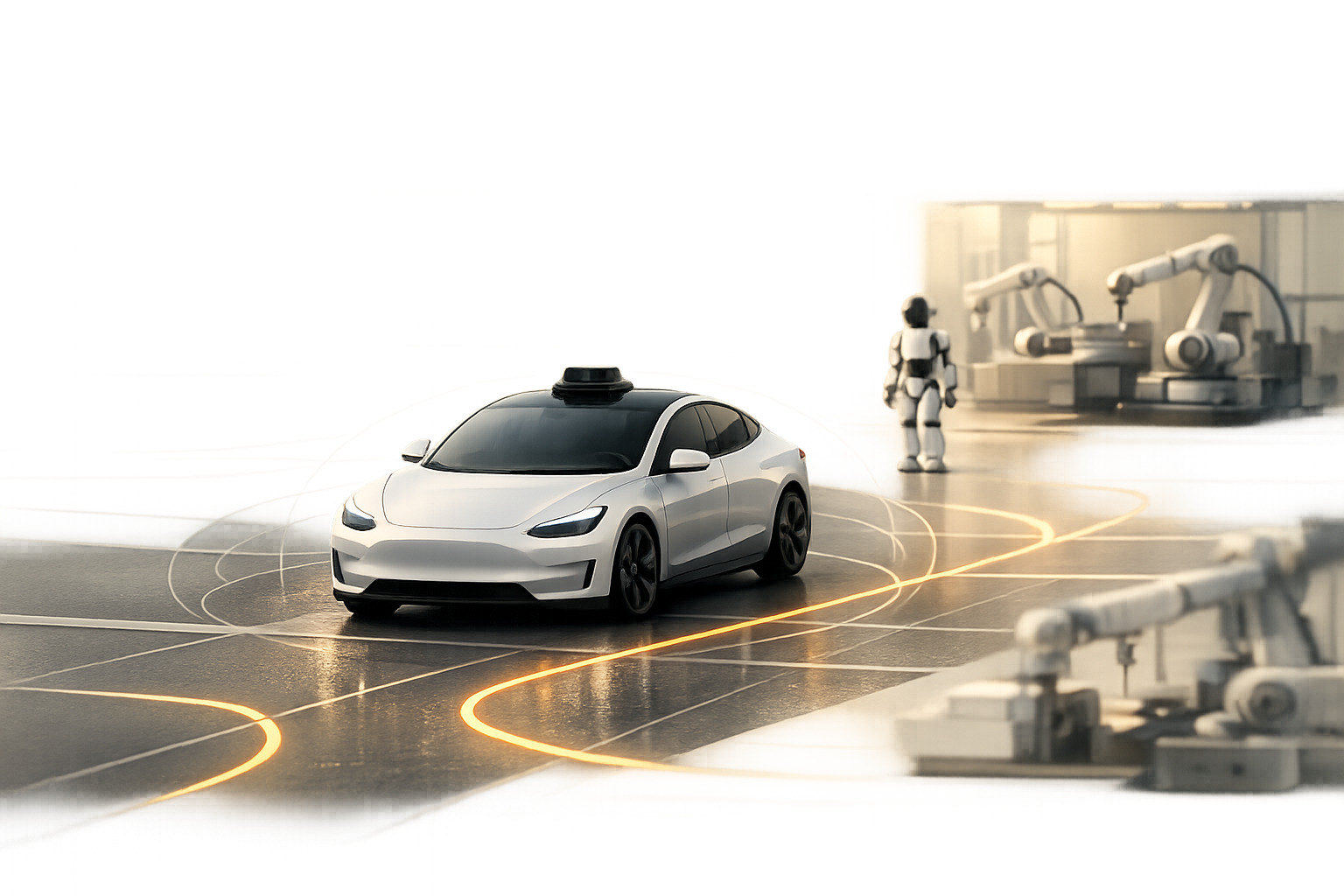
NVIDIA Alpamayo and Tesla FSD: How Far Has the Robotaxi World-Model Race Come?
A Growth × Liquidity comparison of NVIDIA Alpamayo and Tesla FSD: world models, occupancy, end-to-end driving, data flywheels, and platform economics.
The key question is not only who has the same technology, but who captures which layer of the economics.
Conclusion first
NVIDIA Alpamayo points in the same broad direction Tesla has pushed for years with FSD: world models, occupancy-style scene understanding, and end-to-end driving models.
But reducing the comparison to “who has the better software” misses the real investment question. Tesla is strongest where vehicle operation, data collection, OTA deployment, and control are inside one closed loop. NVIDIA is strongest where open models, simulation, hardware reference platforms, safety systems, and partner ecosystems become an industry platform.
1. Is Alpamayo similar to Tesla’s world-model direction?
Directionally, yes.
NVIDIA describes Alpamayo as a family of open AI models, simulation tools, and datasets for safe, reasoning-based autonomous vehicle development. The public framing is not just perception. It is about vehicles that can understand rare long-tail cases, reason through complex scenes, act safely, and explain their decisions.
That overlaps with the direction Tesla has pushed through FSD: moving from a classical stack of separate perception and planning modules toward a system where vision, latent world representation, planning, and action are learned more tightly together.
The technical philosophy can be summarized this way:
- Old architecture: rule-based components, separated perception, separated planning.
- New direction: vision → latent world representation → reasoning/planning/action.
- Tesla: pushes this through an operating vehicle fleet and OTA product loop.
- NVIDIA: turns a similar physical-AI direction into an open AV development platform.
2. Tesla and NVIDIA are not fighting the same battle
The key difference is the business system around the model.
Tesla
Goal: a vertically integrated robotaxi operator running its own vehicles.
Strengths:
- Real-world driving data from Tesla vehicles.
- A camera-first FSD philosophy.
- Hardware, software, OTA updates, and vehicle control in one system.
- A live FSD user base that collects long-tail cases.
- A broader physical-AI thesis across Robotaxi, Cybercab, and Optimus.
Risks:
- Regulatory approval.
- Safety proof, insurance, and liability.
- Musk-time execution risk.
- HW3 credibility issues.
- Investors still need real paid-driverless unit economics.
NVIDIA
Goal: not to operate robotaxis directly, but to sell the AI factory and AV platform that others can build on.
Strengths:
- DRIVE AGX Thor and DRIVE Hyperion reference architectures.
- Cosmos and Omniverse simulation and synthetic-data tooling.
- Alpamayo open reasoning models.
- The Halos safety system.
- A broad ecosystem that can include automakers, mobility platforms, AV developers, and research teams.
- A pick-and-shovel position across training, simulation, in-vehicle compute, and edge AI.
Risks:
- NVIDIA does not have Tesla’s single-company closed fleet-learning loop.
- Partner data is distributed across many firms.
- NVIDIA does not capture the full robotaxi fare economics.
- AV success may drive large platform demand, but the service margin goes to operators.
3. How many years ahead is Tesla in autonomous-driving software?
A single number is misleading. The answer depends on the layer.
A. Productized robotaxi/FSD driving policy software
Tesla likely leads NVIDIA itself by roughly 2–4 years.
Tesla has live vehicle deployment, repeated OTA iteration, real consumer road data, and a single system connecting model, vehicle, and control. Even if Alpamayo is a strong foundation model, turning that model into a paid driverless urban product is a separate problem.
The caveat is important: against Waymo or another live L4 operator, Tesla’s relative position is not automatically dominant. But compared with NVIDIA as a platform supplier, Tesla is closer to direct driving-product deployment.
B. World model, reasoning model, and simulation toolkit
The gap is smaller and uncertain: roughly 0–2 years, with NVIDIA possibly stronger in some toolkit layers.
Tesla has real driving data and deployment integration. NVIDIA has massive accelerated-computing infrastructure, simulation tooling, open model development, and partner requirements across robotics and AV.
The research-model gap may be smaller than the deployment-loop gap.
C. Safety certification, multi-sensor L4 platform, and OEM stack
NVIDIA may be stronger here.
NVIDIA’s strength is not “one company’s FSD.” It is a reusable platform for automakers and robotaxi developers: Hyperion sensor reference architecture, DriveOS, Thor compute, Halos safety system, and simulation validation.
That is different from Tesla’s camera-first in-house robotaxi strategy. For OEMs that cannot buy Tesla FSD, NVIDIA can become the practical industrial-standard candidate.
D. Data flywheel
Tesla may lead by 3–5 years or more.
The most valuable robotaxi data is not generic driving footage. It is the long tail: unprotected left turns, pedestrians, scooters, construction zones, police hand signals, weather, regional driving norms, insurance, and incident data.
NVIDIA can enable partners to fine-tune on fleet data, but Tesla owns the tighter loop.
4. The clean answer
This article’s estimate is:
- Direct robotaxi service software: Tesla leads NVIDIA itself by about 2–4 years.
- Real-world data flywheel: Tesla has a 3–5 year or larger structural advantage.
- Foundation model / reasoning / simulation toolkit: the gap is likely 0–2 years, with some NVIDIA advantages.
- OEM L4 platform, safety, and hardware reference architecture: NVIDIA has the stronger platform position.
- Economic capture: Tesla can capture vehicle, software, and fare economics if it works; NVIDIA sells compute and platform infrastructure to many possible winners.
So Tesla is ahead in running the robotaxi product. NVIDIA is stronger as the global infrastructure provider for many robotaxi builders.
5. Does Alpamayo weaken the Tesla thesis?
The better answer is: it raises the verification burden more than it weakens the thesis.
For Tesla, the positive read is that the industry is adopting the language Tesla has used for years: cars as physical-AI platforms, not just vehicles. World models, end-to-end learning, and embodied AI becoming mainstream can strengthen Tesla’s narrative.
The caution is that Tesla’s monopoly premium weakens if NVIDIA’s ecosystem lets multiple OEMs, mobility providers, and AV companies build credible L4 services. Tesla may still be right on direction, but not alone in the opportunity.
For NVIDIA, the positive read is different. NVIDIA does not have to pick the single robotaxi winner. If AV, robotics, and physical AI expand, NVIDIA can sell the AI factory, simulation, DRIVE compute, and in-vehicle edge stack to many winners.
The caution is that Alpamayo is not an immediate earnings event. Robotaxi deployment remains slow because safety, insurance, regulation, and liability are hard.
6. Growth × Liquidity read
Growth
This event is Growth-positive.
Autonomous driving is being reframed as physical AI:
- world models,
- simulation,
- edge inference,
- robotaxi fleets,
- data factories,
- and safety certification.
That strengthens both the Tesla and NVIDIA narratives.
Liquidity
The liquidity read is different. These are high-multiple long-duration stories. If rates, risk appetite, or market liquidity deteriorate, good technology can still face multiple compression before revenue proof arrives.
- Liquidity-friendly market: Tesla and NVIDIA narrative premiums can expand.
- Liquidity-hostile market: investors may demand real robotaxi revenue, FSD retention, utilization, and platform orders before paying up.
7. Final view
Technical philosophy: Alpamayo looks similar to the world-model / end-to-end / physical-AI direction Tesla has pushed. It does not prove Tesla was wrong. It suggests Tesla’s direction is becoming an industry language.
Technology gap: Tesla is ahead in productized driving software and real-world data flywheel. NVIDIA is strong in foundation models, simulation, safety systems, and OEM platforms.
Investment interpretation: Tesla gets thesis reinforcement and monopoly-premium risk at the same time. NVIDIA gets a stronger platform thesis because it can benefit even if several robotaxi winners emerge.
Classification:
- Tesla: a core candidate, but chasing price before paid driverless operations, insurance data, fleet utilization, and FSD subscription retention are visible is risky.
- NVIDIA: a core candidate. Alpamayo is less a near-term earnings trigger than a long-term physical-AI platform option.
- Robotaxi ecosystem: Uber, OEMs, sensors, power, edge compute, and simulation names remain watchlist candidates.
One sentence: NVIDIA is taking Tesla’s world-model direction and turning it into an open industrial platform. Tesla is ahead in deployment and data; NVIDIA has the broader infrastructure position across many potential winners.
Source-use standard
This article uses NVIDIA’s public Alpamayo announcement, NVIDIA DRIVE Hyperion materials, Tesla AI Day 2022, and Tesla FSD public materials. The technology-gap estimates are interpretive judgments based on public evidence and industry structure, not a stock-price timing call.
Korean version: Read the Korean version