When Can LONGi Rebound? China Solar Is Not Dead, but Shareholders Need Discipline
China’s solar industry is not a dead industry. Demand is still growing. The problem is that supply grew even faster, triggering price wars, losses, and a painful shareholder cycle. LONGi may survive the shakeout, but the stock still needs evidence before a durable rebound can be trusted.
China solar is not dead. It was overbuilt.
IEA data show that renewable additions reached roughly 800 GW in 2025, with solar PV accounting for more than 600 GW. China alone commissioned around 370 GW of solar PV in 2025. On demand alone, solar remains a large growth industry.
The problem is manufacturing capacity. CSIS notes that China dominates polysilicon, wafers, cells, and modules by a wide margin. Reuters and CNBC describe an industry whose manufacturing capacity can meet roughly twice global demand, resulting in price wars, margin compression, and losses. The industry can grow while shareholders still suffer.
Demand is not profit
- Demand grows with electrification and energy security.
- Supply remains excessive in China’s manufacturing base.
- Profits need pricing and utilization recovery.
- Stocks need evidence, not only a demand story.
2025 narrowed the loss; Q1 2026 weakened again.
LONGi’s 2025 revenue was CNY 70.347 billion, down 14.82% year over year. Net loss attributable to shareholders was CNY 6.420 billion, narrower than the 2024 loss of CNY 8.592 billion. Operating cash flow turned positive at CNY 4.359 billion. That supported a “worst is easing” interpretation.
Q1 2026 did not confirm the turn. Revenue fell 18.03% year over year to CNY 11.192 billion. Net loss attributable to shareholders widened to CNY 1.920 billion, and operating cash flow was negative at CNY 2.449 billion. The next few quarters matter more than the narrative.
CNY 12 is an area to watch, not a confirmed bottom.
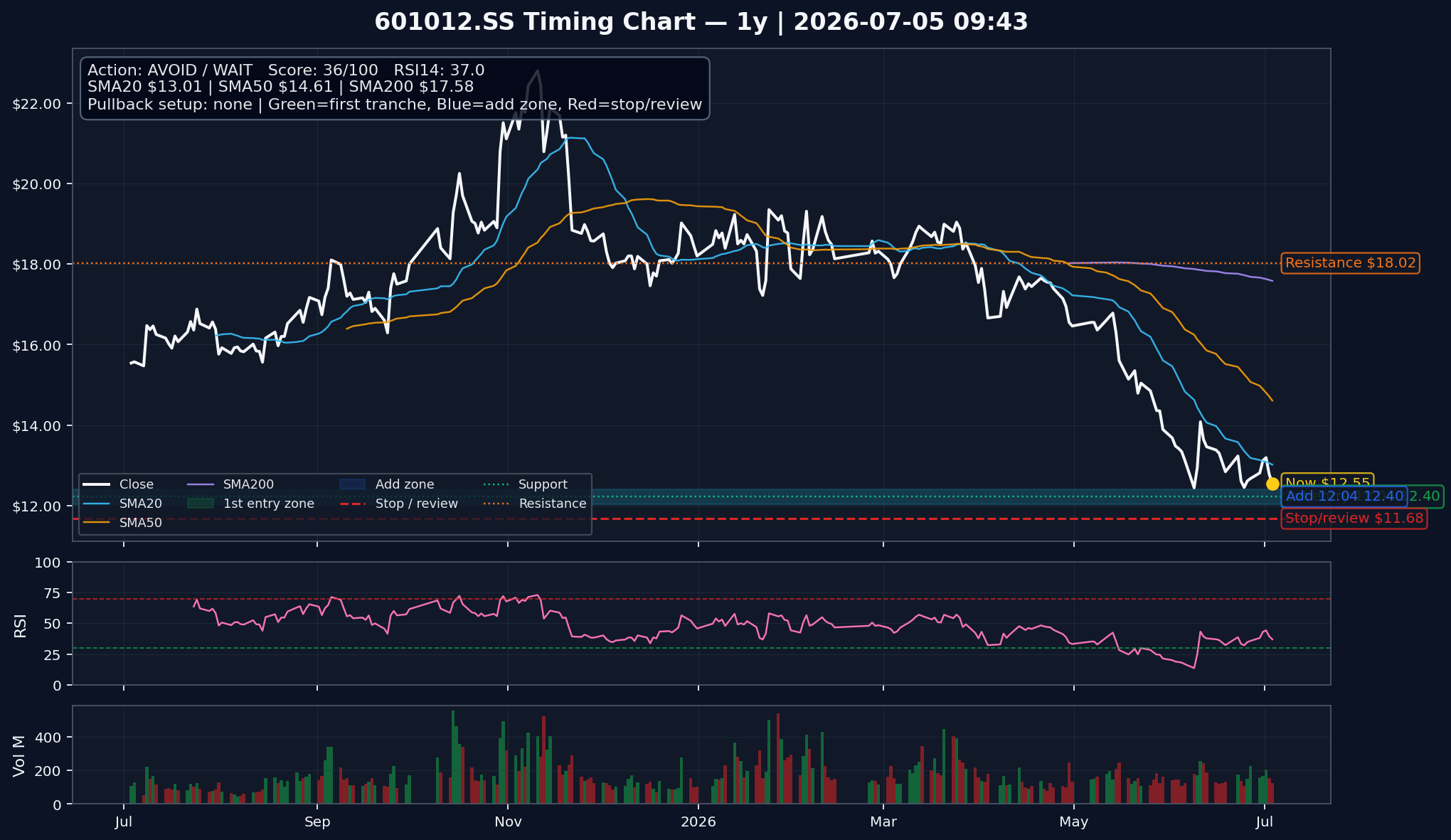
| Metric | Level | Read-through |
|---|---|---|
| Current price | CNY 12.55 | Very close to the 52-week low near CNY 12.22. |
| Drawdown from 52-week high | -46.8% | The decline is large, but losses make drawdown alone insufficient. |
| SMA20 / SMA50 / SMA200 | 13.01 / 14.61 / 17.58 | The stock remains below all key moving averages. |
| RSI14 | Near 36 | Close to oversold territory, but not a bottom signal by itself. |
| Support / review line | 12.0–12.4 / 11.7 | A break below this area would keep the stock in a weak trend. |
The rebound should be read in three stages.
Oversold bounce
A hold around CNY 12.0–12.4 and a reclaim of CNY 13 can create a short bounce. That is not a trend change.
Tradable rebound
A reclaim of the 50-day moving average near CNY 14.6, combined with Q2/Q3 loss narrowing, would make staged entry more reasonable.
Durable turn
Module and wafer pricing must hold, operating cash flow must improve, and profitability must become visible. That is more likely late 2026 into 2027.
Anti-involution must turn from slogan into actual closures.
Reuters frames polysilicon consolidation as a test of China’s broader overcapacity reform. CNBC reports that Chinese authorities have called for coordinated measures including capacity control, pricing enforcement, mergers, and intellectual-property protection. These are important signals.
But restructuring is hard. Local governments may resist closing factories in their own regions, and producers may increase output again when prices rise. Investors should therefore track actual utilization, inefficient-capacity exits, and price durability rather than policy language alone.
There are early pricing signals.
PV Tech and pv magazine reported late-2025 and early-2026 price increases across wafers, cells, and modules, with LONGi and other leading wafer producers lifting quotes. The key question is whether customers accept those prices through contracts.
BC/HPBC and storage are the right survival strategy.
LONGi’s 2025 materials highlight the ramp of HPBC 2.0. The company cited mainstream module power of 650–660W, peak power of 670W, and maximum mass-production conversion efficiency of 24.8%. It also reported 46 GW of in-house HPBC 2.0 cell capacity and 11 GW of collaborative capacity by year-end 2025, with 22.87 GW of BC module sales.
This matters because commodity module scale alone does not protect shareholders in a price war. LONGi needs its technology advantage to become average-selling-price premium, margin repair, and cash flow. Its solar-plus-storage expansion is directionally sensible, but the market will trust it more when the income statement improves.
Watch first, size later.
| Investor type | Current action | Buy condition | Review condition |
|---|---|---|---|
| Long-term investor | Watch first | Q2/Q3 loss narrowing and CNY 14.6 reclaim | Failed consolidation, wider losses, or break below CNY 11.7 |
| Staged-entry investor | Only a small probe near CNY 12 | Reclaim CNY 13, then retest; later reclaim 50DMA | Break and failure to recover CNY 12 |
| Momentum investor | Wait | 20DMA and 50DMA reclaim with volume | Bounce stalls below CNY 13 |
| Conservative investor | No buy before earnings evidence | Operating cash-flow repair, price stability, visible profitability | Overcapacity remains unresolved next quarter |
Growth is alive, but liquidity alone is not enough.
The Growth side of solar remains attractive: electrification, energy security, renewable deployment, and storage integration support long-duration demand. But LONGi’s stock is more sensitive to pricing and margin than to installations alone. Easier liquidity can help, but it cannot fully repair a price war.
The biggest bias is “industry growth equals stock upside.”
- More solar installations do not automatically mean higher LONGi profits.
- A 47% drawdown can be attractive, but losses can make it a value trap.
- Policy announcements are not the same as actual capacity exits.
- A good company and a good entry price must be separated.
Investment view: LONGi is not a throwaway company, but it remains a watchlist name.
LONGi is a likely survivor in China’s solar shakeout. That does not make the stock an immediate core holding. CNY 12 is an interesting area, but the stock needs a reclaim of CNY 13, then CNY 14.6, and—more important—Q2/Q3 evidence of loss narrowing before sizing becomes attractive.
China solar is not a permanently broken industry. It may become even larger in the global energy transition. The shareholder problem is that oversupply must be cleared and pricing power must return before growth turns into profit. The early rebound window is the second half of 2026; the higher-conviction turn is late 2026 into early 2027.
Public sources checked
This article combines LONGi official reports, CSIS/Reuters/CNBC coverage of China’s solar shakeout, IEA demand and supply-chain data, and PV Tech / pv magazine pricing signals.
- LONGi — 2025 Annual Report
- LONGi — First Quarter Report 2026
- LONGi — 2025 annual-report summary
- CSIS — China’s Solar Industry Is in Upheaval
- Reuters — China’s overcapacity crackdown and polysilicon test
- Reuters — China solar losses narrowing
- CNBC — China calls for concerted efforts on solar overcapacity
- IEA — Global Energy Review 2026: Solar PV and wind
- IEA — Solar PV overview
- PV Tech — China PV prices rise in tandem
- pv magazine — China wafer leaders lift quotes
This article is general educational market commentary based on public company materials, major news coverage, and public market data. It does not incorporate each reader’s taxes, FX exposure, transaction costs, or risk tolerance.
Telegram: https://t.me/signalandflow