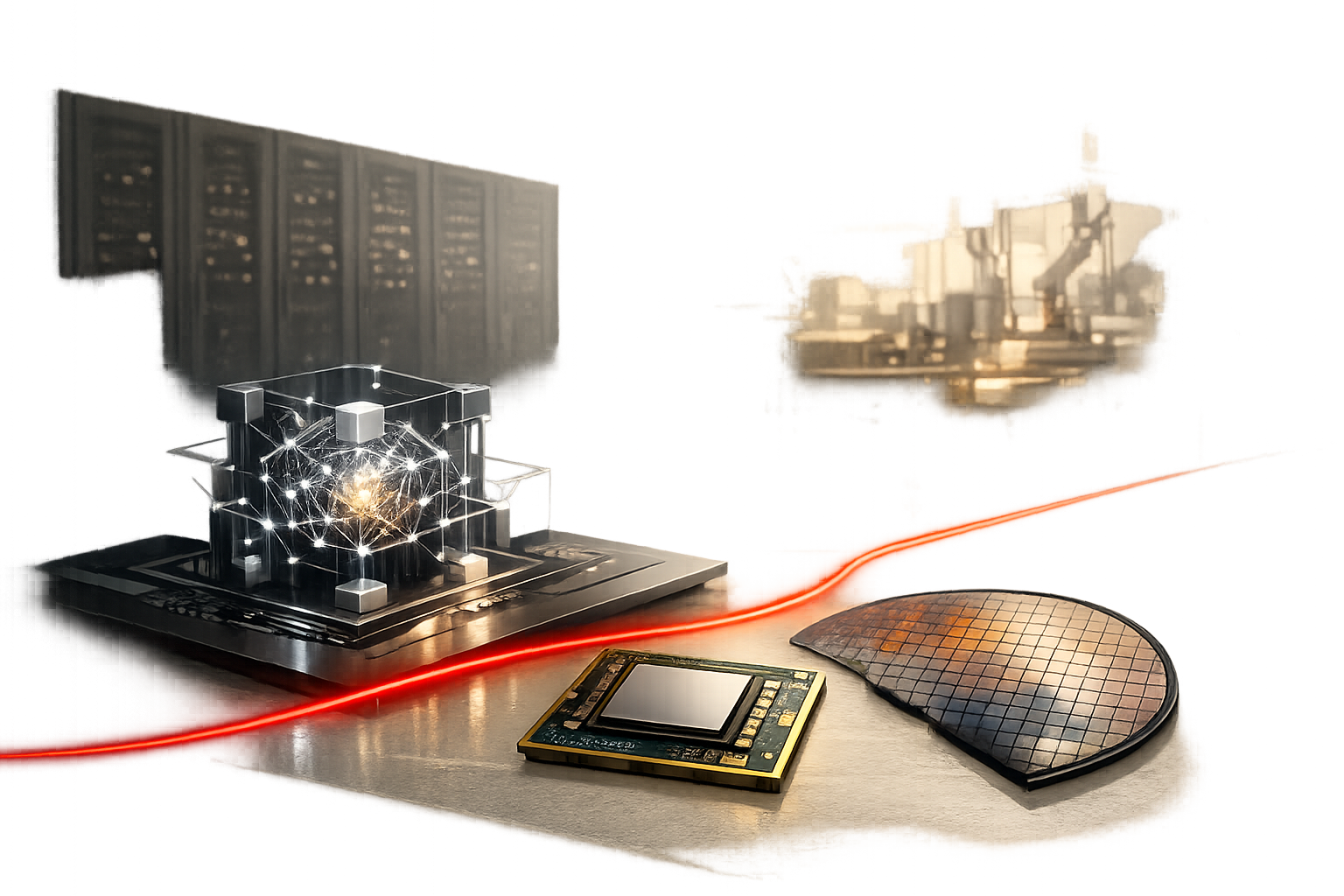
Computex 2026: How NVIDIA RTX Spark and N1X Differ From Apple M5
A Signal & Flow visual brief on Computex 2026, NVIDIA RTX Spark/N1X versus Apple M5, and bottleneck beneficiaries across AI PCs and AI factories.
The point is not the phrase “AI PC”; it is finding the bottlenecks that can show up as revenue.
Visual decision map
The article keeps the original argument, but this table-first layer makes the comparison easier to scan.
| Axis | Apple M5 | NVIDIA RTX Spark / N1X | Investment read |
|---|---|---|---|
| Identity | Efficient integrated SoC for the Apple ecosystem | Windows local AI-agent workstation platform | N1X matters more as CUDA ecosystem expansion than as one PC chip |
| AI philosophy | Neural Accelerators inside GPU cores plus Neural Engine | Blackwell GPU, Tensor Cores, CUDA and RTX stack | Developer and creator AI workloads can deepen NVIDIA lock-in |
| Software moat | Metal, Core ML, Apple Intelligence | CUDA, TensorRT, NIM, NeMo, RTX AI, Windows tools | The key question is who controls the AI workflow standard |
| Memory | Efficient unified-memory architecture | GPU-centric unified memory for AI workloads | Local LLM, agent, and rendering workloads turn memory into a bottleneck |
| Strength | Battery, quiet devices, integration, Apple apps | CUDA, RTX, local AI development, Windows reach | Apple wins finish; NVIDIA has broader industrial optionality |
| Rank | Bottleneck | Beneficiaries | Why it can become revenue | Key checkpoint |
|---|---|---|---|---|
| 1 | HBM / high-end memory | SK hynix, Micron, Samsung | Rubin-generation AI factories cannot scale without HBM | HBM4 approval, yield, ASP, NVIDIA share |
| 2 | Advanced process / packaging | TSMC | NVIDIA, Apple, AMD, Broadcom and custom ASIC demand all compete for capacity | 3nm/2nm capacity, CoWoS expansion, geopolitical risk |
| 3 | Power / cooling | Vertiv, Eaton, Schneider, Delta | Without power and cooling, AI factories cannot operate purchased GPUs | Liquid-cooling adoption, data-center power orders, valuation |
| 4 | Networking / optical | Arista, Broadcom, Marvell, Coherent, Lumentum | Larger GPU clusters make rack-to-rack communication a bottleneck | Spectrum-X versus open Ethernet; 800G/1.6T transition |
| 5 | Windows AI PC ecosystem | MediaTek, Dell, HP, Lenovo, ASUS, Acer | N1X adoption can create PC replacement demand | OEM adoption, app compatibility, enterprise replacement cycle |
Bottom line first
The core message of NVIDIA GTC Taipei 2026 is that NVIDIA is trying to redefine not only the data-center AI factory but also the PC as a CUDA-based local AI-agent platform. Apple M5 is a highly efficient integrated Apple Silicon platform. NVIDIA RTX Spark / N1X is closer to a Windows AI PC platform for developers and creators, combining Blackwell GPU + Grace/Arm CPU + CUDA + Windows + local agents.
For investors, the important question is not simply whether “AI PCs” become a theme. The better question is where bottlenecks can form and where those bottlenecks can translate into revenue.
- First bottleneck: TSMC 3nm, advanced packaging, CoWoS-like capacity
- Second bottleneck: HBM, high-capacity LPDDR, memory bandwidth
- Third bottleneck: data-center power, liquid cooling, networking, optical connectivity
- Fourth bottleneck: Windows on Arm plus CUDA application ecosystem adoption
My beneficiary map:
- Core candidates to hold/watch closely: NVIDIA, TSMC, SK hynix, Micron, Vertiv, Arista, Broadcom
- Waitlist candidates: MediaTek, Dell, HP, Lenovo, ASUS, Acer, Quanta, Foxconn, Delta Electronics
- Observation list: Adobe, Arm, Marvell, Coherent, Lumentum, Schneider, Eaton
This is not a timing call for chasing stock prices. It is an industry map based on potential revenue beneficiaries.
1. What the keynote was really about
The video is NVIDIA GTC Taipei 2026 Keynote | Live. Based on the transcript and public source checks, three points matter most.
A. NVIDIA frames itself as an AI factory system company, not just a GPU company
Jensen Huang described AI agents as more than a simple LLM call. They require model, runtime, tools, memory/KV cache, CPU orchestration, GPU inference, DPU/BlueField security, storage, network, power, and cooling. The message is that an AI workload does not end with one GPU. It becomes a factory-scale system of racks, networking, power, cooling, and software.
B. Vera Rubin is not just a GPU; it is a multi-rack AI-agent supercomputer
The Vera Rubin section highlighted Vera CPU, Rubin GPU, NVLink 72, BlueField, Spectrum-X Ethernet, liquid cooling, TSMC 3nm, HBM suppliers including Micron, SK hynix and Samsung, optical connectivity, and AI-factory-level power/cooling optimization.
The key variable is no longer only GPU performance. It is inference cost, cost per token, and throughput per watt. NVIDIA is selling AI factory productivity.
C. RTX Spark / N1X means NVIDIA is re-entering the PC market
The most important PC-related section was RTX Spark / N1X. The keynote described a Blackwell RTX GPU, 6,144 CUDA cores, one petaflop of AI performance, a custom 20-core Grace CPU co-developed with MediaTek, NVLink CPU-GPU fusion, 128GB unified memory, TSMC 3nm, 70 billion transistors, tight Windows integration, and full NVIDIA CUDA / AI / graphics software-stack support.
This is not merely a gaming GPU laptop. It is a PC where a local AI agent can operate creative, design, development, and cloud-model workflows.
2. How it differs technically from Apple M5
In one line: Apple M5 is an efficient integrated SoC. NVIDIA N1X / RTX Spark is a Blackwell PC platform that brings the CUDA ecosystem into the laptop.
Apple M5 is strongest in power efficiency, battery life, Mac/iPad/Vision Pro integration, and the Apple app ecosystem. NVIDIA N1X / RTX Spark is stronger as a general AI-development ecosystem: CUDA, PyTorch, TensorRT, NIM, NeMo, RTX AI, Adobe, Blender, Rhino, AI developer tools, local agent sandboxes, and Windows PCs.
The central difference is philosophy. Apple puts Neural Accelerators into the GPU and optimizes the whole device around Apple’s ecosystem. NVIDIA puts Blackwell GPU, CUDA, Tensor Cores, and Windows AI workflows at the center.
Apple M5 can run local AI. But NVIDIA is emphasizing a richer local agent workstation: reading files, using tools, controlling CAD/3D/video/developer applications, moving between cloud and local models, and continuously executing work.
3. Revenue beneficiaries
The right lens is not “good company” alone. It is where bottlenecks can form and where revenue can jump.
NVIDIA / NVDA
RTX Spark / N1X can expand NVIDIA from data centers into PC SoCs. Vera Rubin, NVLink, Spectrum-X, and BlueField strengthen NVIDIA’s AI factory standard. The revenue levers are GPU, AI PC SoC, networking, software stack, DGX/RTX, and enterprise AI.
Classification: core candidate. Price still needs separate judgment.
MediaTek / 2454.TW
The keynote said the custom 20-core Grace CPU was co-developed with MediaTek. If MediaTek becomes NVIDIA’s Windows AI PC Arm CPU partner, its TAM can expand beyond smartphones, TVs, and connectivity chips.
Classification: waitlist candidate until volume and margin structure are visible.
TSMC / TSM, 2330.TW
RTX Spark / N1X and Vera Rubin both point to TSMC advanced process and packaging. If AI PCs and AI factories scale together, the bottleneck becomes leading-edge manufacturing plus advanced packaging.
Classification: core bottleneck candidate.
SK hynix, Micron, Samsung Electronics
AI factories cannot scale without HBM. Rubin-generation HBM4 can make memory shortage visible in numbers. SK hynix remains the clearest HBM leader, Micron is a U.S. high-end memory beneficiary, and Samsung has upside if it confirms HBM share recovery.
Classification: SK hynix and Micron are closer to core candidates; Samsung remains a waitlist candidate until HBM leadership improves.
Arista, Broadcom, Marvell
As AI factories move from racks to clusters, the bottleneck spreads from compute to network fabric. NVIDIA is pushing Spectrum-X, but hyperscalers also want open Ethernet and multi-vendor architectures.
Classification: Arista and Broadcom are core candidates; Marvell is a watch/wait candidate.
Vertiv, Eaton, Schneider, Delta Electronics
AI factories cannot operate without power and cooling. The keynote emphasized power, cooling, grid integration, and liquid-cooling systems. This layer can become a very real revenue bottleneck.
Classification: Vertiv is a core candidate, while Eaton, Schneider, and Delta are waitlist candidates depending on valuation.
Dell, HP, Lenovo, ASUS, Acer, Quanta, Foxconn, Compal
If RTX Spark / N1X becomes a real Windows AI PC product line, OEM and ODM revenue can rise. But PC OEM/ODM margin capture is usually weaker than chip, memory, packaging, or power-infrastructure layers.
Classification: waitlist candidates.
4. Ranking the bottlenecks
1. HBM and high-end memory: SK hynix, Micron, Samsung
2. TSMC advanced process and packaging: TSMC
3. Power and cooling: Vertiv, Eaton, Schneider, Delta Electronics
4. Networking and optical: Arista, Broadcom, Marvell, Coherent, Lumentum
5. Windows AI PC SoC ecosystem: MediaTek, Dell, HP, Lenovo, ASUS, Acer
5. Growth and liquidity view
The keynote expands the AI growth axis into three lanes: cloud AI factories, enterprise/industrial agentic AI, and local AI PCs/workstations. Growth remains strong, and NVIDIA is expanding from individual GPUs into AI factory, PC, and software-stack platforms.
The liquidity issue is different. AI infrastructure requires massive CapEx. If rates, power availability, data-center ROI, or customer payback periods weaken, valuation multiples can compress even when the technology story is strong.
So the conclusion is simple: the industry thesis is stronger, the beneficiary map is broader, but stock chasing should be separated by company, valuation, and timing.
Final view
Technically, Apple M5 is an efficient Apple-ecosystem SoC. NVIDIA N1X / RTX Spark is a CUDA-based Windows AI-agent PC platform. M5 is stronger in battery life and Apple integration. N1X is stronger in local AI development, CUDA, RTX, Tensor Cores, and Windows tool ecosystems.
The highest-priority beneficiary list is:
- Core candidates: NVDA, TSM, SK hynix, MU, AVGO, ANET, VRT
- Waitlist candidates: MediaTek, Samsung Electronics, DELL, HPQ, Lenovo, ASUS, Delta, Eaton
- Observation list: Marvell, Coherent, Lumentum, Adobe, Arm, Acer, Quanta, Foxconn
The point is not to buy the phrase “AI PC.” The point is to buy the bottlenecks that can show up as revenue.
Source-use standard
This article uses the NVIDIA GTC Taipei 2026 keynote transcript in the Computex 2026 context as the starting point, then cross-checks key product and platform claims against public NVIDIA and Apple materials. The beneficiary map is a revenue-bottleneck framework, not a stock-price timing call.
Korean version: Read the Korean version