RESEARCH BRIEF · Growth × Liquidity
Conclusion: AI is becoming a physical infrastructure cycle
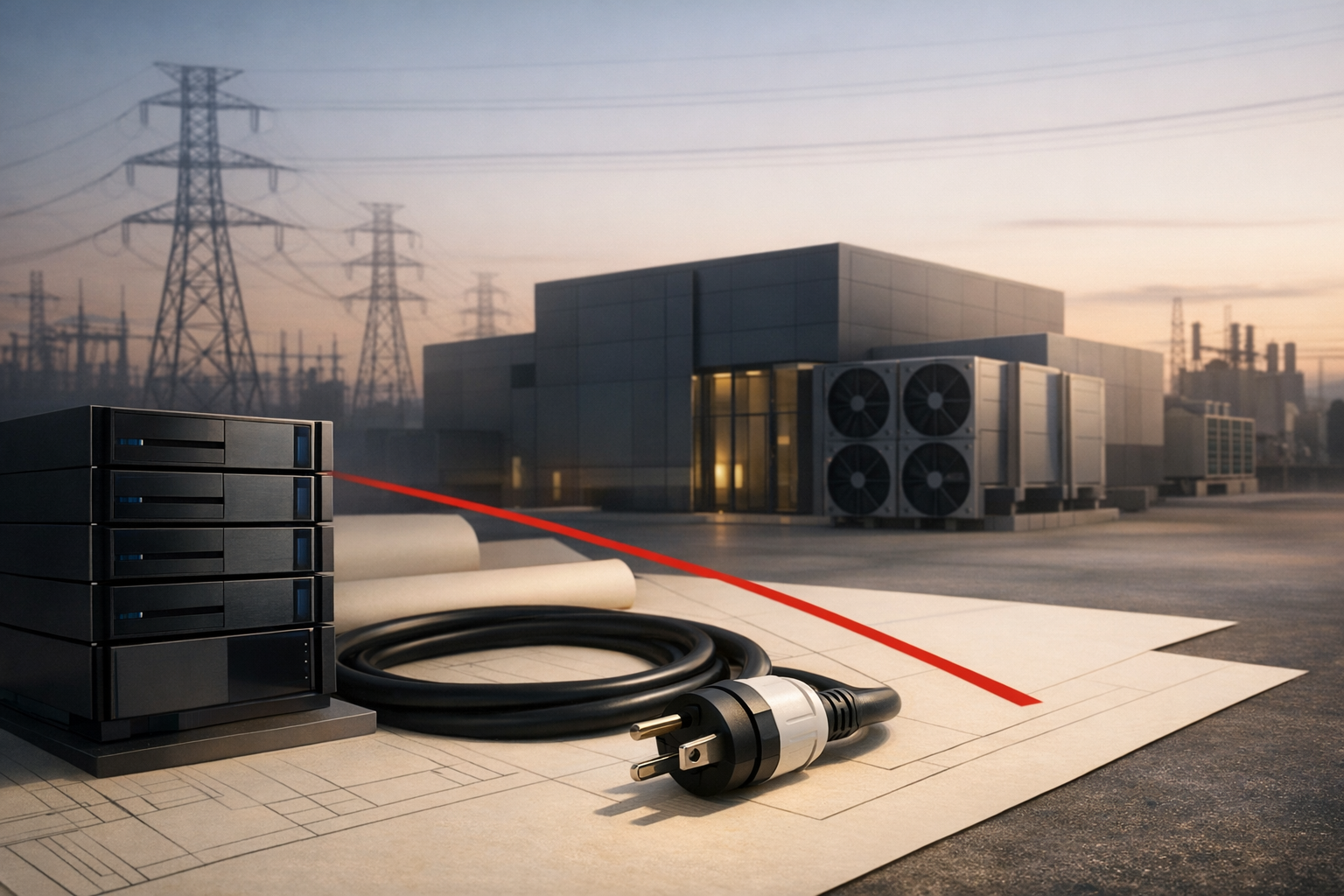
The AI debate has often focused on model quality, GPU supply, and which software product will capture the user. That frame is no longer enough. As AI moves from training labs into daily enterprise and consumer usage, the investment bottleneck is shifting toward power, land, cooling, grid interconnection, networking, and the cost of capital.
AI demand can still grow strongly, but the market will increasingly reward platforms that can convert that demand into usable capacity. The next premium may go not to the company with the loudest AI story, but to the operator that can secure power faster, finance infrastructure at a lower cost, and sign credible long-term customers.
Why this topic matters now
Several market themes meet at the data-center power bottleneck. AI equity valuations are being tested by the question of whether huge capital expenditure will turn into durable revenue. Rates and credit conditions determine whether long-lived infrastructure projects clear their return hurdles. Real estate looks weak in many traditional categories, but data-center sites with power access can behave like scarce strategic assets. Politics also enters the picture because grid expansion, generation mix, permitting, water use, and local electricity costs are no longer background variables.
That is why this article is not just another note about whether AI stocks will rise. The deeper question is this: when the next constraint on AI growth is the physical world, which companies and assets deserve the scarcity premium?
1. Political layer: AI leadership becomes a permitting and grid question
AI competition appears to be a fight among models and cloud platforms, but large-scale data centers pull the competition into public policy. A major AI data center can demand the power profile of a large industrial site. Interconnection queues, substations, transmission lines, cooling water, land use, local electricity prices, and community resistance all become political issues.
This creates a new investment filter. Politically acceptable power is not just an input; it is a strategic asset. Two companies can buy similar GPUs, but one may obtain grid access within a shorter window while another waits years. That time difference can become a larger business advantage than a small model-quality difference.
Governments that view AI as national infrastructure may accelerate grid upgrades, generation capacity, nuclear restarts, gas generation, renewable connections, and permitting reform. Local resistance can slow projects in the opposite direction. The result is that AI infrastructure growth is not decided by corporate capex alone. It is decided by the interaction of energy policy, regional permits, and community tolerance.
2. Economic layer: AI growth is being translated into the language of rates
AI is a growth story, but data centers are also a financing story. Servers and GPUs are only part of the bill. Land, buildings, power equipment, cooling, network capacity, security, and long-term power contracts all require capital before the cash return arrives.
That makes data centers a direct meeting point for Growth and Liquidity. On the growth side, cloud usage, enterprise automation, AI agents, search, coding, media, and scientific workflows create more inference demand. On the liquidity side, the same demand requires large upfront spending. Investors must therefore ask not only whether AI usage is rising, but also whether the spending can become free cash flow.
Lower rates would support the theme by reducing discount rates and financing costs for long-duration projects. Higher rates would raise the hurdle and force more discrimination. In a tighter liquidity environment, the market tends to reward operators that already control power, sites, customers, and balance-sheet flexibility.
3. Technology layer: the bottleneck moves from GPUs to tokens per watt
The technical center of gravity is moving from building larger models toward running useful models at scale. Training remains important, but daily inference can become the recurring load. Once users and enterprises call AI systems billions of times, the key variables become token cost, tokens per watt, latency, cooling efficiency, and regional capacity.
This widens the investment map. GPUs and accelerators remain important, but so do HBM, high-speed networking, power semiconductors, transformers, switchgear, cables, cooling systems, data-center operators, power assets, and energy companies that can structure long-term contracts.
The visible software winner may still be uncertain. The need for compute, power, and efficient infrastructure is more direct. That is why the market can rotate from pure software narratives toward the infrastructure chain when investors seek evidence rather than promises.
4. Investment interpretation: beneficiaries and risk zones
The largest mistake is to simplify the idea into “AI uses more power, therefore every related stock is attractive.” The more useful view separates likely beneficiaries from fragile exposures.
Potential beneficiaries include data-center operators with real power access and creditworthy long-term customers; electrical equipment and grid infrastructure suppliers; utilities or generation owners that can earn regulated or contracted returns; and big technology platforms that can prove capex translates into cloud revenue, AI usage, and cash flow.
Risk zones include data-center announcements without secured power, high-valuation AI software companies that cannot pass infrastructure costs to customers, and broad real-estate exposure that ignores the difference between data centers, housing, offices, and retail assets.
5. Real-assets connection: data centers are becoming power options
Data centers look like real estate, but their investment essence is increasingly closer to a power option. A site with grid access, cooling feasibility, customer demand, and financing capacity can be more valuable than a site with only a good address.
Traditional real estate is constrained by mortgage rates, transaction volume, refinancing, and local demand. Data centers also feel rates, but their demand source is different: AI usage and cloud demand. That is why a data-center site with scarce power access can attract capital even when other property categories remain pressured.
Soft warning and kill switch
The thesis weakens if AI inference demand grows more slowly than expected, model efficiency improves so quickly that power forecasts are revised down, long-term rates rise again, local political resistance delays projects, or big technology companies reduce data-center capex together.
The kill-switch signals are clear: simultaneous capex cuts by hyperscalers, cloud AI revenue slowing while capex keeps rising, grid investment costs failing to translate into utility returns, data-center rents or preleasing weakening, and infrastructure financing markets tightening sharply. If those signals appear, the power-bottleneck premium should be reassessed.
Reader checklist
- Has the company secured actual power access, or only announced a plan?
- Are the customers creditworthy long-term counterparties?
- Can the project still earn acceptable returns if rates stay high?
- Which bottleneck does the business solve: power, cooling, networking, land, or financing?
- Does AI usage convert into revenue and cash flow, not only traffic?
- Is valuation already assuming a perfect future?
Public evidence and interpretation standard
Major real-estate and market sources, including JLL’s data-center outlook and financial-media coverage of hyperscaler AI capex, point to a large multi-year infrastructure cycle and meaningful grid-access constraints. The exact numbers should be read with caution, but the mechanism is durable: AI growth is becoming inseparable from power availability, infrastructure execution, and liquidity conditions.
Educational research only. This article is not a recommendation to buy or sell any security. Investors should verify price, liquidity, valuation, and personal risk constraints before making decisions.