From AWS to shopping, advertising and delivery
A business that benefits when AI completes work
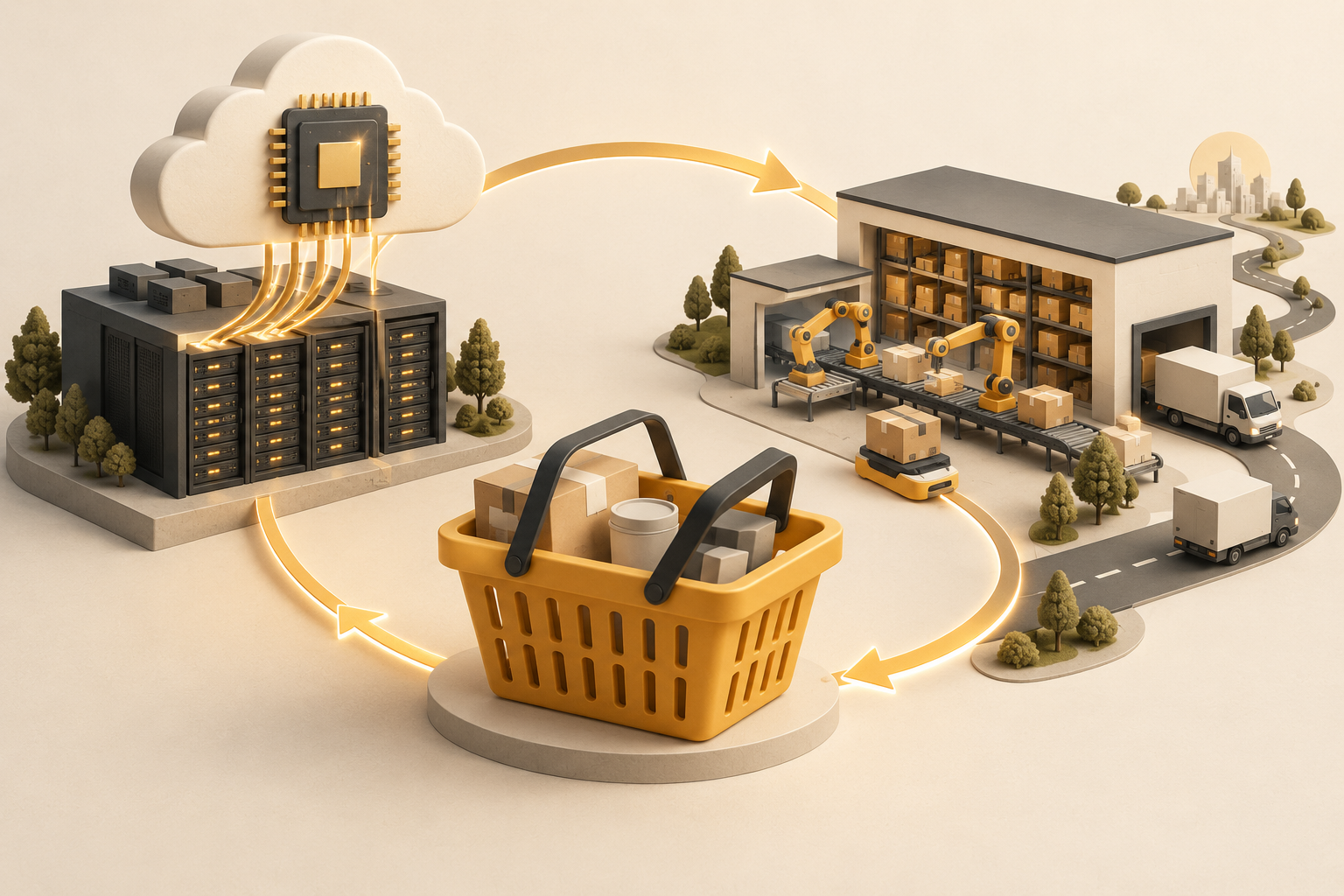
Viewing Amazon’s AI investment only through data centers and AWS revenue leaves out an important part of the business. AI also helps customers choose products, advertisers reach buyers and fulfillment centers process orders. Technology sold to external customers can also increase sales or reduce costs inside Amazon.
Tigress Financial’s Ivan Feinseth describes an integrated AI flywheel and raised his Amazon price target from $315 to $385. The useful question is how the connections between businesses produce earnings. [11]
My assessment is conditionally positive. Amazon can sell compute as AI usage grows and benefit when AI supports purchases or improves delivery. Its reported results nevertheless show a large investment burden alongside better profitability. Growing operating income does not mean the investment has already paid back.
The AWS opportunity extends beyond model calls
Consider a company building an AI customer-service agent. Choosing a response model is only one step. It also has to retrieve order records, check access rights, record requests and recover from failed actions. Production use creates demand for databases, storage, CPUs and security as well as inference.
Jassy says AI demand drives core cloud usage while existing applications and data support AI adoption. That is management’s business interpretation, not proof of incremental spending or investment returns for every customer. [3]
| Amazon offering | Customer problem | Condition for monetization |
|---|---|---|
| Bedrock | Select and invoke suitable models | Experiments become recurring paid usage |
| AgentCore | Deploy, connect and operate agents | Production workloads consume managed services |
| Trainium / Graviton | Control AI and general compute costs | Performance, migration costs and utilization work economically |
Bedrock provides access to models from multiple companies; AgentCore supports agent deployment, connections and operations. Customers may change models while keeping data and production infrastructure on AWS. They can also move clouds or operate their own infrastructure. Retention is an opportunity, not a guarantee. [5] [6]
Amazon continues to develop its own models. Nova 2.5 Sonic, released on October 5, improves reasoning and tool use for real-time voice agents. A release in one category does not establish leadership across the frontier-model market. [10]
Shopping AI works close to a purchase decision
Shoppers do not want to spend longer reading search results. They want a product that fits their budget and purpose, at a reasonable price and with reliable delivery. AI can reduce the work of comparison and choice. Amazon already operates the place where the resulting transaction can happen.
Rufus was renamed Alexa for Shopping on May 13, 2026. It offers product comparisons, price information and purchasing under specified conditions. Availability can vary by country and account. [7]
Advertising can enter the conversation. Amazon Ads describes sponsored placements and conversational product and brand prompts in Alexa for Shopping. If those placements answer a specific need and lead to purchases, merchants may obtain better results from their budgets. This is a monetization hypothesis, not evidence that AI caused the entire increase in advertising revenue. [8]
Prime can support the next visit. Useful delivery and bundled benefits give customers reasons to return. AI personalization may add value, but product prices, selection and delivery quality also matter.
| Company-reported observation | Interpretation boundary |
|---|---|
| US Alexa for Shopping users spend over 40% more per order on average | Customers already intending to buy more may use AI more |
| Customers who tried Alexa+ sign up for Prime at a nearly 25% higher rate | Not presented as a causal experiment controlling for group differences |
Both observations come from the Q2 announcement. They suggest a connection with purchasing, not equivalent increases in incremental revenue or profit caused by AI. The signup comparison is not a 25-percentage-point increase. [1]
AI can change the cost of handling an order
Order economics matter alongside sales growth. Better robot routes, inventory placement and fewer delays can allow a facility to handle more orders. Equipment maintenance, electricity, software and labor costs must still be included in the calculation.
Amazon introduced DeepFleet in June 2025 and described a 10% improvement in robot travel time. This was a company claim about robot movement efficiency, not a 10% reduction in total fulfillment costs or staffing. [9]
These applications show AI expanding from generating answers to executing digital work and coordinating physical activity. The evidence needs to be assessed separately for each technology. Warehouse robotics provides a setting for operational measurement; it does not mean general-purpose robotics has been fully commercialized.
Amazon’s scale offers a place to apply small improvements broadly and to observe what fails in actual operations. The place where it develops and tests technology is close to the place where that technology can earn money. That proximity may become an advantage.
This does not imply unrestricted pooling of costs or data across businesses. AWS customer data and shopping data remain subject to their respective permissions, contracts and privacy protections. Shared technology and operating experience should not be confused with unlimited combination of customer information.
The margin improvement is visible
Q2 2026 shows higher profitability. Amounts below are USD billions. Margins are calculated as operating income divided by sales. [1]
| Metric | Q2 2025 | Q2 2026 |
|---|---|---|
| Total sales | 167.702 | 200.606 |
| Total operating income | 19.171 | 27.461 |
| Total operating margin | 11.4% | 13.7% |
| AWS sales | 30.873 | 42.232 |
| AWS operating income | 10.160 | 16.621 |
| AWS operating margin | 32.9% | 39.4% |
| Advertising sales | 15.694 | 19.809 |
Calculated from these figures, AWS accounts for about 21.1% of sales and 60.5% of operating income. That makes AWS economics central to Amazon’s earnings. The contribution does not establish that all AWS growth is generative-AI revenue.
Profit quality also matters. The 10-Q reports approximately $0.640 billion of tariff refunds and $0.551 billion of unrealized energy-contract gains. Simply subtracting both gives a total operating margin of about 13.1%. The improvement remains, but this is a comparison calculation in this article, not a company-reported adjusted margin. [2]
The $53.4 billion of pretax non-operating other income was primarily related to Anthropic investments. It should not be read as operating profit or cash earned by selling AWS AI services. [2]
Earnings growth and investment recovery differ
For the twelve months ended June 2026, operating cash flow was $161.403 billion. Cash property-and-equipment purchases net of sales and incentives were higher, at $169.007 billion. Amazon-defined FCF was therefore -$7.604 billion. These are comparable-period figures. [2]
161.403 – 169.007 = -7.604 [2]
AI services can earn money while FCF falls if investment for the next wave of demand rises faster. Equally, cutting investment to increase cash flow is not automatically positive if growth opportunities are weakening. Cash earned by operating assets and cash spent on new assets need separate attention.
At its July earnings announcement, Amazon increased expected 2026 capital spending to about $220 billion. The company-wide plan centers on AI but also includes robotics, semiconductors and satellites. It is neither entirely AI spending nor an amount already spent. [12]
Tigress’s argument about profit outgrowing invested capital belongs in this context. The summarized note does not define the capital measure, comparison periods or after-tax operating profit calculation. Comparing one quarter’s profit growth with asset growth over another period cannot establish improving ROIC.
Revenue overlap is another trap. Amazon describes AI and custom-chip businesses with annualized revenue run rates exceeding $25 billion each. The same service usage can appear in both categories. They should not be added into $50 billion of new revenue. Run rates also differ from quarterly revenue and contracted backlog. [3] [4]
Five questions that test the growth thesis
Amazon has opportunities across several directions of AI development. Enterprise deployment can use AWS; shopping and advertising can benefit when customers choose products; logistics can improve when orders are fulfilled. This structure does not require one Amazon model to win every competition.
| What to track | Evidence strengthening the thesis | Evidence weakening the thesis |
|---|---|---|
| AWS growth and profitability | Paid demand rises while margins hold | Pricing and depreciation overwhelm sales gains |
| Shopping and ad economics | Repeat purchases and ad outcomes improve | Recommendation distrust, returns or inference costs rise |
| Fulfillment unit costs | Costs fall without weaker service | Equipment and operating costs offset efficiency |
| Capital spending and FCF | New capacity contributes sales and cash | Low utilization, more investment or power delays postpone recovery |
| Capital returns and valuation | Match periods, average capital and price | Use business optimism to justify any price |
External agents could also become the starting point for shopping. Amazon might still provide transactions and delivery while losing influence over product discovery and recommendations. This is a competitive scenario, not an established market-share change.
Business growth and a stock’s entry price require separate calculations. The $385 target belongs to Tigress. Its valuation assumptions are not reproduced here, so the target is not adopted as independently estimated fair value. Future margins, reinvestment needs and cash recovery must be assessed against the price.
Amazon sells AI and uses it inside its own business. There is evidence of better profitability. The next assessment should examine operating profitability after depreciation and cash left after reinvestment. Growth in AI usage becomes more persuasive when both improve.
Sources and measurement notes
Research cutoff: October 7, 2026. Financial comparisons use Q2 2026 and Q2 2025; cash flow uses the twelve months ended June 2026. Features and usage outcomes are provider-reported. Monetization pathways and competitive scenarios are the interpretation of this article.
[1] Amazon Q2 2026 earnings release
2026-07-30
[2] Amazon Q2 2026 Form 10-Q
Period ended 2026-06-30
[3] Andy Jassy on AWS, AI and core cloud growth
Q2 2026 earnings commentary
[4] Amazon custom silicon: Trainium, Graviton and Nitro
Q2 2026 business context
[5] Amazon Bedrock
Accessed 2026-10-07
[6] Amazon Bedrock AgentCore
Accessed 2026-10-07
[7] Rufus / Alexa for Shopping capabilities
Renamed 2026-05-13
[8] Agentic shopping and advertising
2026-06-11
[9] DeepFleet and Amazon’s millionth robot
2025-06-30
[10] Amazon Nova 2.5 Sonic release
2026-10-05
[11] Tigress Financial price-target revision / The Fly
Analyst view, not company guidance
[12] AP: Amazon’s revised 2026 capital-spending plan
2026-07-30
Margins and shares are calculated from reported figures and rounded to one decimal place. Removing tariff refunds and energy-contract gains is a simple comparison, not a comprehensive normalization including taxes or other adjustments.