

AI · PHYSICAL AI · GROWTH × LIQUIDITY
Jensen Huang’s Next AI Roadmap: A Physical AI Beneficiary Map Beyond Robot Stocks
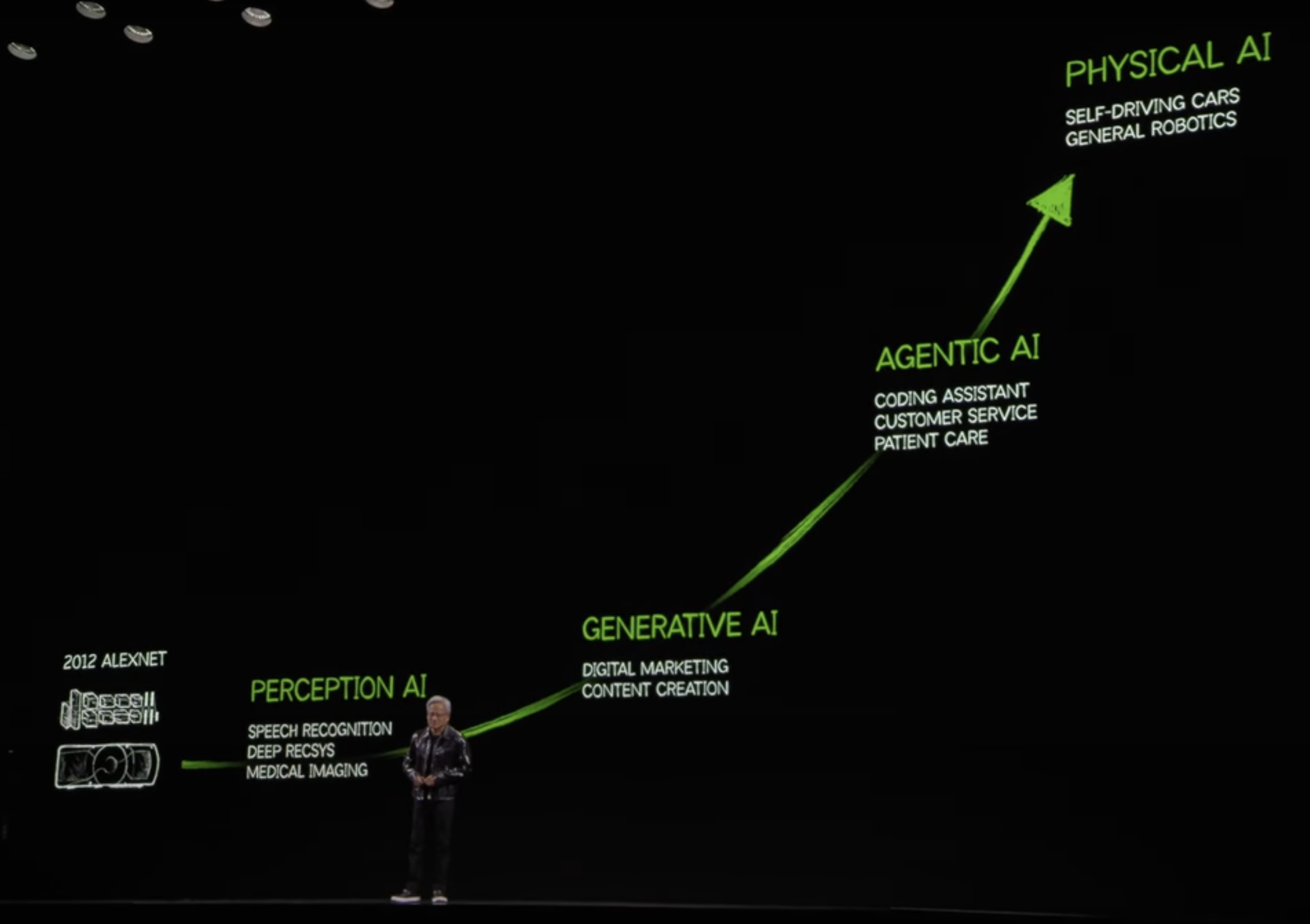
The GPT phase repriced GPUs. The agent-AI phase repriced inference servers, CPUs, memory, networking, and data-center infrastructure. Jensen Huang’s next roadmap, Physical AI, moves AI from screens and software workflows into factories, warehouses, vehicles, hospitals, power systems, and industrial equipment. Investors should map the value chain before chasing the most visible robot headline.
Physical AI value-chain map
| Layer | Signal | Public examples | Bottleneck | Investor read |
|---|---|---|---|---|
| Platform and simulation | CORE | NVDA, TSLA, GOOG | World models, synthetic data, digital twins, robotics runtime | Owning the standard platform can compound even if the visible robot OEM winner changes. |
| Warehouse and logistics automation | ROI | SYM, AMZN, ZBRA | Repetitive tasks, labor constraints, inventory/picking optimization | This is the most measurable early deployment zone for Physical AI. |
| Industrial control and factory automation | CONTROL | ROK, ABBNY, SIEGY, FANUY, TER | PLCs, motion control, safety certification, virtual commissioning | AI must connect to existing factory-control and safety layers before it can move equipment. |
| Vision and sensing | PERCEPTION | CGNX, ZBRA, MBLY, ON, ADI | Inspection, localization, tracking, safety judgment | Physical AI must perceive before it acts; sensing errors become safety and quality risk. |
| Edge AI semiconductors | EDGE | QCOM, NXPI, AMBA, TXN | Low-latency, low-power on-device inference | Robots and vehicles cannot wait for the cloud, so inference moves closer to the device. |
| Power, actuation, and industrial hardware | POWER | ETN, SBGSY, HON, CAT, DE | Power distribution, motors, drives, field equipment | Physical AI ultimately consumes electricity and moves motors; infrastructure matters. |
Price thermometer
The table uses public Yahoo/yfinance data as of the 2026-05-08 U.S. close. These numbers are not buy signals; they show how much of the theme may already be priced in.
| Ticker | Layer | Price | YTD | 1Y | 52W position | Forward P/E | Temperature |
|---|---|---|---|---|---|---|---|
| NVDA | Platform | 215.2 | 14.0% | 84.5% | 97.5% | 19.1 | Hot |
| TSLA | Platform | 428.35 | -2.2% | 43.6% | 68.8% | 169.0 | Mid-high |
| SYM | Logistics | 52.29 | -19.4% | 111.3% | 44.6% | 69.0 | Watch |
| ROK | Control | 453.89 | 13.9% | 54.0% | 94.5% | 31.5 | Upper |
| FANUY | Robotics | 24.35 | 23.6% | 91.4% | 99.2% | 36.3 | Hot |
| TER | Robotics/test | 359.77 | 73.3% | 364.7% | 82.0% | 37.8 | Upper |
| ZBRA | Traceability | 226.03 | -9.0% | -15.3% | 17.6% | 11.3 | Watch |
| CGNX | Vision | 65.66 | 77.8% | 122.8% | 85.5% | 39.5 | Upper |
| QCOM | Edge | 219.09 | 26.7% | 50.9% | 91.6% | 20.6 | Upper |
| NXPI | Edge | 294.75 | 33.2% | 53.6% | 92.4% | 16.7 | Upper |
| ON | Sensing | 103.2 | 82.0% | 151.8% | 95.9% | 24.2 | Hot |
| ETN | Power | 401.51 | 22.7% | 29.6% | 73.6% | 25.6 | Mid-high |
| SBGSY | Power | 64.35 | 15.9% | 32.5% | 86.2% | 24.1 | Upper |
| ABBNY | Automation | 106.5 | 44.1% | 96.1% | 99.8% | 31.3 | Hot |
| ISRG | Medical robotics | 450.06 | -19.9% | -16.1% | 12.6% | 38.2 | Watch |
Why Physical AI is a distinct investment cycle
Language models mostly operate inside text and software, where failure costs are lower. Physical AI moves machines near people and production lines. It needs scarce data, high-fidelity simulation, safety validation, industrial integration, and edge inference. That is why NVIDIA’s emphasis on Cosmos, Isaac, GR00T, and Omniverse is not only a GPU story; it is a full-stack attempt to own how physical-world AI is trained, tested, and deployed.
The strongest layer: platforms and simulation
NVIDIA remains the structural platform candidate because Cosmos, Isaac, Omniverse, Jetson, and data-center GPUs sit across training, simulation, edge inference, and deployment. Tesla is a vertically integrated option through Optimus, FSD, manufacturing data, and in-house AI infrastructure, but the stock also carries auto-margin and valuation risk. Alphabet has long-duration optionality through Gemini, DeepMind, Waymo, and Isomorphic Labs, but its listed-company exposure to robot revenue is still indirect.
The earliest ROI layer: logistics and factory automation
The first measurable ROI may come from warehouses and factories. Symbotic has high warehouse-automation exposure. Zebra supplies traceability through barcode, RFID, mobile computing, and machine-vision workflows. Rockwell, ABB, Siemens, Fanuc, and Teradyne are less flashy, but they sit closer to industrial control, robotics, test, and virtual commissioning. Existing installed bases can matter more than press-release excitement once deployment moves into real capex budgets.
Hidden bottlenecks: vision, sensors, and edge inference
Robots must perceive before they act. Machine vision, traceability, autonomous-driving perception, industrial sensors, and low-power edge AI chips can benefit across multiple robot ecosystems. Cognex, Zebra, Mobileye, ON Semiconductor, Analog Devices, Qualcomm, NXP, and Ambarella are examples of enabling layers that can win even if no single humanoid vendor dominates.
Power and industrial hardware are also Physical AI
Physical AI consumes electricity and moves motors. Eaton and Schneider Electric sit in power and electrification. ABB and Siemens combine power, automation, and robotics. Honeywell, Caterpillar, and Deere connect automation to buildings, aerospace, construction, agriculture, and heavy equipment. They do not look like classic robot stocks, but they are part of how physical-world intelligence becomes deployed infrastructure.
Growth × Liquidity judgment
The growth vector is strong: robot installations and industrial automation keep expanding, and NVIDIA’s official ecosystem is broadening from chips into world models, simulation, and edge deployment. The liquidity vector is more delicate: many AI, automation, and industrial names already trade near 52-week highs. Treat the theme as a watchlist and value-chain map, not an automatic buy signal.
Investor checklist
- Is robotics or automation revenue appearing in reported numbers, or is the story still mostly partnerships?
- Is customer concentration high enough that one delayed project can change the thesis?
- Is the stock already priced near the top of its 52-week range?
- Does AI functionality improve pricing, margins, replacement demand, or customer ROI?
- Could industrial capex, power availability, or AI infrastructure margins become a Kill Switch?
Kill Switch and Soft Warning
- Kill Switch: robotics orders slow, major customer projects slip, industrial capex weakens, or AI infrastructure margins deteriorate.
- Soft Warning: the stock rallies on the theme while reported Physical AI revenue remains small or inventory correction persists.
- Bias check: do not assume a company is superior simply because the word robot appears in the story.
Public sources checked
Checked NVIDIA official announcements, IFR industrial-robot statistics, company product and industrial-AI pages, and public Yahoo price data. Some dynamic or paywalled pages were used through their public titles and official descriptions rather than full-text quotation.
- NVIDIA Newsroom — Cosmos World Foundation Model Platform
- NVIDIA Newsroom — Global Robotics Leaders Take Physical AI to the Real World
- International Federation of Robotics — World Robotics 2025
- Rockwell Automation — Industrial AI
- Cognex — OneVision AI machine vision
- Qualcomm — Robotics RB3 Platform
- NVIDIA Developer — Isaac GR00T
- Symbotic — Warehouse automation solutions
- Yahoo Finance public market data
This article is for education and research only and is not a recommendation to buy or sell any security. Public price data is supporting context; verify the latest filings, earnings, and valuation before making investment decisions.