
Why the Fed Looks Past Food and Energy When Reading Inflation
A plain-English Signal & Flow explanation of the latest FRED Blog post on core PCE: why the Fed looks past food and energy, and what that means for growth and liquidity.
The Fed looks past food and energy not because they are unimportant, but because it needs a cleaner view of the medium-term inflation trend that policy can influence.
Core PCE needs to cool for rate-cut expectations and risk-asset liquidity to improve more sustainably.
Broad consumption prices
Ex-food and energy
Key market channel
The short version
The Fed does not exclude food and energy because groceries and gasoline do not matter. It does so because monetary policy is aimed at the inflation trend that may persist over the next year or two, not every short-term jump in the prices people notice most.
The latest FRED Blog post explains this through core PCE inflation. The Fed watches many price measures, but its preferred broad inflation gauge is the personal consumption expenditures price index, or PCE. Within that, core PCE removes food and energy.
A simple analogy helps.
Headline inflation is today’s weather outside. Core PCE is closer to a thermometer for the season.
A sudden storm matters, but a central bank cannot redesign the heating system every time the weather changes. Rate policy works with a delay. That is why the Fed wants a cleaner signal for the underlying inflation path.
1. Excluding food and energy does not mean ignoring household pain
For households, food, electricity, gas and gasoline are often the first prices they feel. So it is reasonable to ask: why remove the items that hurt most?
The answer is that the Fed is asking a different question.
- How expensive did life feel this month?
- Is inflation likely to keep running hot?
- If rates change today, where is inflation likely to be one or two years from now?
The first question needs headline inflation. The second and third questions often require core PCE.
Food and energy prices can swing sharply because of weather, crop conditions, oil supply, refining capacity, geopolitics and seasonal demand. If the Fed reacted mechanically to every swing, policy would become unstable.
2. Rate policy is slow medicine, not an instant painkiller
The key point in the FRED post is that monetary policy does not affect prices immediately. A rate hike does not lower inflation tomorrow. A rate cut does not revive demand next week.
The chain usually looks like this:
- Loan and deposit rates adjust.
- Households and businesses rethink borrowing.
- Spending, investment and hiring plans change gradually.
- Demand changes, and prices respond later.
That lag is why the Fed cares about the inflation trend, not only the last price shock. A temporary energy spike may be painful, but it may not be the same thing as persistent inflation pressure.
3. CPI, PPI, PCE and core PCE in plain English
The names can feel technical, but the roles are straightforward.
| Measure | Plain-English meaning | What investors should watch |
|---|---|---|
| CPI | Prices consumers pay directly | Cost of living, wage pressure, political pressure |
| PPI | Prices at the producer level | Cost pressure, margins, possible pass-through |
| PCE | A broader measure of household consumption prices | The Fed’s preferred policy inflation gauge |
| Core PCE | PCE excluding food and energy | A cleaner signal for the medium-term inflation trend |
The FRED post emphasizes that PCE covers a broader set of household expenses than CPI or PPI. Core PCE is not perfect. It is useful because it is usually more stable when the Fed is trying to forecast future inflation.
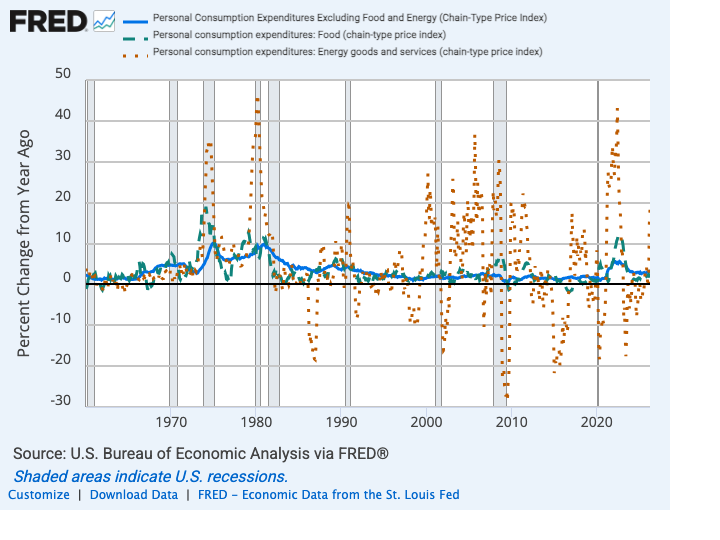
Source: U.S. Bureau of Economic Analysis via FRED, Federal Reserve Bank of St. Louis
4. Think in terms of signal and noise
The FRED post uses an engineering phrase: signal-to-noise ratio.
In simpler terms:
- Signal means the underlying inflation trend.
- Noise means temporary volatility from weather, oil, seasons or supply shocks.
Food and energy prices matter, but they are noisy. Oil prices can move on geopolitics or refining bottlenecks. Food prices can move on crops and transportation costs.
If the Fed overreacts to noise, it can tighten too much after a temporary shock or ease too early after a temporary relief. Core PCE helps answer the more durable question: is inflation really cooling?
5. Why this matters for Growth × Liquidity
For Signal & Flow, this is a liquidity question.
If headline inflation falls because gasoline drops, but core PCE stays sticky, the Fed may remain cautious. That can keep rates higher for longer and pressure valuations.
If headline inflation is temporarily high because food or energy jumped, but core PCE continues to slow, the Fed may have more room to consider future easing.
The practical read is:
- Growth: Lower inflation can support consumption and investment, but high rates can still slow growth.
- Liquidity: Core PCE needs to cool for rate-cut expectations, bond yields, the dollar and risk appetite to improve together.
- Prices: Markets react most sharply when the data changes the Fed path, not simply when a headline number looks good or bad.
6. The political, economic and technology layers
Politics
Food and energy prices are politically sensitive because voters feel them immediately. The Fed, however, has to separate household pain from the policy signal. It must distinguish temporary price shocks from persistent inflation.
Economics
Sticky core PCE can delay rate cuts. That affects mortgage rates, business funding, housing liquidity, credit conditions and the valuation of growth stocks. Long-duration growth assets are especially sensitive to the rate path.
Technology and data
Inflation analysis is increasingly a data problem. The useful question is not only “what was the number?” but “which components are temporary, which are persistent, and which measure best predicts the future?” Public tools such as FRED matter because they let investors see the components rather than only the headline.
7. A practical checklist for investors
On inflation days, use an order of operations:
- Check headline PCE.
- Check core PCE versus expectations.
- Ask whether food and energy drove the surprise.
- Watch services inflation and wage-related pressure.
- Watch bond yields and the dollar.
- See whether equities respond through growth leadership or defensive rotation.
- Do not overread one month; check whether Fed communication and the next data point confirm the same direction.
8. Soft Warning and Kill Switch
A Soft Warning appears when headline inflation looks better but core PCE does not cool. The market may celebrate at first, but the rally can fade if the Fed remains cautious.
A Kill Switch appears when core PCE, services inflation and wage pressure all re-accelerate together. That can push rate-cut expectations back, lift long yields, strengthen the dollar and pressure risk assets.
The constructive scenario is different: core PCE cools, services inflation softens, and employment does not collapse. That is the cleaner version of liquidity relief without major growth damage.
9. Bias check
First, watch the lived-experience bias. Prices you personally see every week are important, but they may not equal the medium-term inflation trend.
Second, watch the headline bias. A single inflation headline may not be the number the Fed cares about most.
Third, watch the wishful-thinking bias. If investors want a rally, they may focus only on a better headline number and ignore sticky core inflation.
Final take
The message of the FRED Blog post is simple.
Food and energy prices are crucial for household budgets, but they are often too volatile for forecasting the medium-term inflation path. That is why the Fed looks at PCE and especially core PCE when judging the policy direction.
For investors, the lesson is also simple: do not stop at “inflation was good” or “inflation was bad.” Ask whether core PCE changes the likely Fed path. Growth and liquidity often turn at that point.
Public source-use standard
This article explains the June 4, 2026 FRED Blog post in plain language and connects it to liquidity interpretation. The original source explains the indicator; the market interpretation here is Signal & Flow’s reader-facing framing.