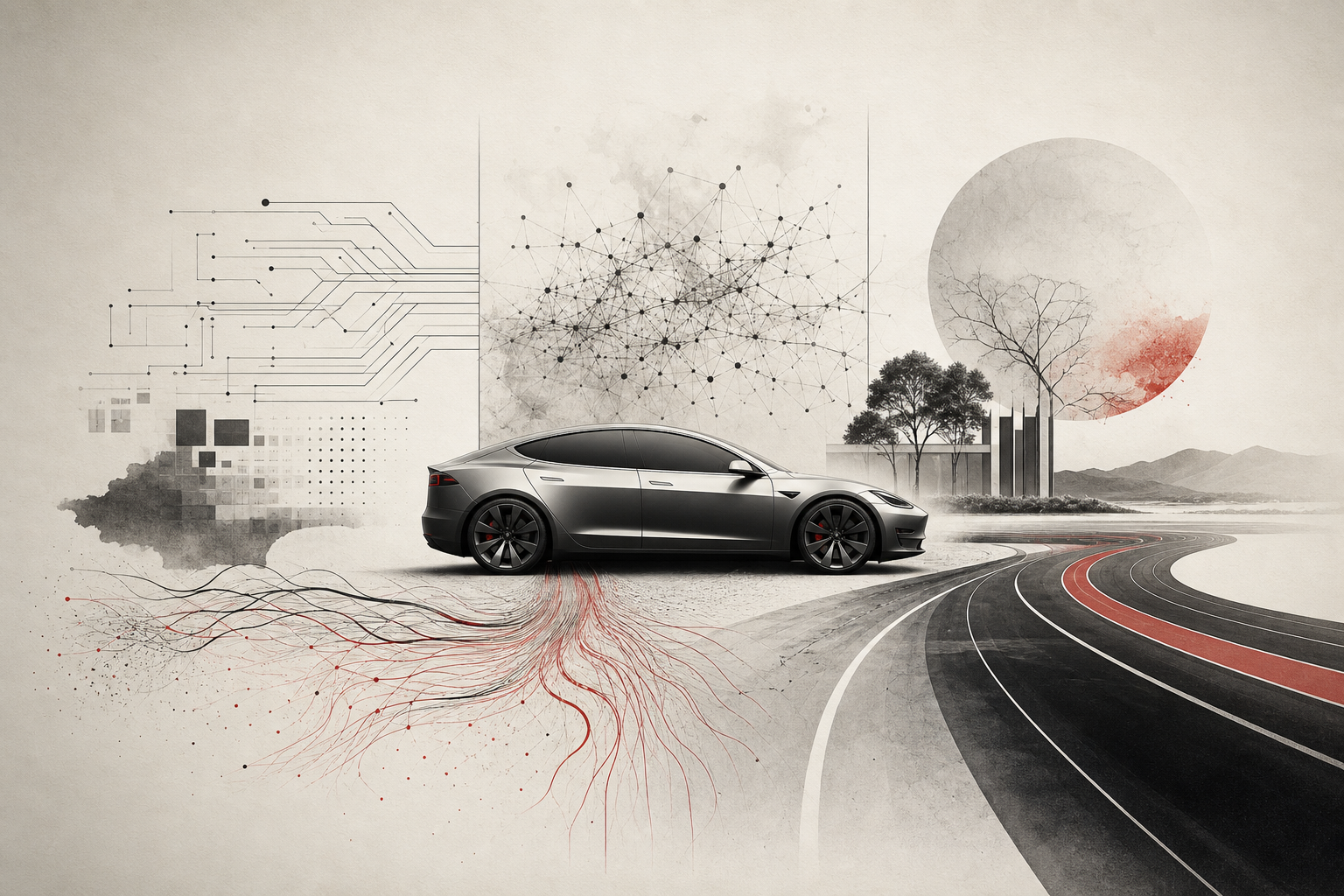
Why Tesla FSD Is Physical AI: From Rules to End-to-End Driving and Back to Control
A Signal & Flow interpretation of Tesla FSD through Jensen Huang’s AI roadmap: perception, generative behavior, agentic control, and physical AI.
Core thesis: Tesla FSD is not merely an EV feature. It is a transition from rule-based software to learned end-to-end behavior, and then to a controlled physical AI system.
Mapping the AI roadmap to Tesla
Cameras, BEV, lanes, vehicles, pedestrians, and traffic lights.
The model generates trajectories rather than text.
Destination, actors, lane choice, and replanning become one loop.
The output moves a real car in the physical world.
From rules to E2E to control
Humans write driving logic.
The model learns driving behavior.
The system verifies and constrains actions.
Failures become training data.
Autonomy becomes embodied.
Bottom line
Tesla FSD is not just an EV feature getting better. It is a compact case study of a broader AI transition: from rule-based software, to learned end-to-end behavior, and then back to a new control layer that verifies and governs the learned behavior.
That is why the Tesla FSD story resembles the transition from GPT to agentic AI. GPT moved language systems away from hand-written rules into learned models, and then required tool permissions, verification, guardrails, and execution control. Tesla is attempting a similar transition in the physical world, where the output is not text but steering, acceleration, braking, and real-world motion.
This does not mean Tesla has already completed unsupervised autonomy. Tesla’s product is still officially Full Self-Driving Supervised. The point is the technological direction: FSD is a live example of the path Jensen Huang describes as AI moving from perception, to generation, to agency, and finally to Physical AI.
Jensen Huang’s AI roadmap
The attached roadmap can be read as four stages.
| Stage | Meaning | Examples |
|---|---|---|
| Perception AI | AI that sees and recognizes the world | speech recognition, recommendations, medical imaging, object detection |
| Generative AI | AI that produces text, images, code, and content | ChatGPT, image generation, content creation |
| Agentic AI | AI that receives goals, reasons, plans, and acts | coding agents, customer service agents, workflow automation |
| Physical AI | AI that understands and acts in the physical world | self-driving cars, robots, humanoids |
The key shift is from generating answers to acting with intelligence.
Tesla through the roadmap
In the Perception AI stage, Tesla’s problem was whether the car could understand roads, lanes, vehicles, pedestrians, traffic lights, and obstacles from cameras. Tesla’s AI page describes autonomy at scale across vehicles and robots, and neural networks that learn from real fleet scenarios. This is the “eyes and spatial understanding” layer of autonomy.
The rule-based stage came next. The system could perceive the scene, but much of the decision logic still depended on hand-written planning and control rules. That works in simpler environments, but urban driving creates an endless long tail: construction zones, ambiguous lanes, double-parked cars, hand gestures, unprotected turns, local driving cultures, and edge cases.
The end-to-end transition changes the software question. Instead of writing rules for every situation, the model learns driving behavior from large-scale video and action data. In simplified form, GPT learns the next token from language context; FSD learns the next driving action or trajectory from road context.
| GPT / LLM | Tesla FSD |
|---|---|
| Humans do not hand-code grammar rules | Humans do not hand-code every driving rule |
| Large text corpora train next-token behavior | Large driving video/action data train next-driving behavior |
| The model generates natural language | The model generates natural driving trajectories |
| Distributional learning replaces brittle rules | Real driving distribution replaces hand-written exceptions |
| Language model becomes an agent | Lane keeping becomes urban driving agency |
Why control after E2E matters most
End-to-end does not mean “let the neural network do anything.” The hard part is what comes after: how to verify, constrain, evaluate, deploy, monitor, and improve the learned policy.
Agentic AI has the same problem. A language model that can use tools needs permissions, logs, verification, rollback, human-in-the-loop approval, sandboxing, and evaluations. FSD needs the physical equivalent: fleet data, simulation and replay, intervention data, safety monitors, supervised deployment, OTA rollout discipline, edge-case mining, and large-scale evaluation.
In both cases, the moat moves from the model alone to the operating system around the model.
Why Tesla is a Physical AI case
A self-driving car is an AI agent in the physical world. It receives a destination, perceives the environment, reasons about surrounding actors, plans a path, acts through steering and acceleration, observes the new state, and replans. That loop is agentic, but because the action happens in the real world it becomes Physical AI.
Tesla’s broader thesis also includes Optimus. The overlap is meaningful: perception, spatial understanding, motion planning, control, simulation, real-world feedback, edge inference, and safety all matter in both autonomous driving and robotics.
Investment interpretation
The long-term Tesla thesis is therefore not simply “EV unit growth.” It is whether Tesla can convert real-world driving data, edge inference, closed-loop learning, FSD, Robotaxi, and Optimus into a physical-world AI platform.
The evidence to watch is practical: lower FSD intervention rates, less need for supervision, broader geographic generalization, regulatory approvals, real Robotaxi operations, FSD take rate, unit economics, Optimus factory-task performance, and the cost/performance curve of training and inference.
The risks are just as practical: long-tail safety validation, regulatory delay, accident-driven trust loss, competition from Waymo-style L4 systems, EV margin pressure, and delayed Robotaxi or robotics monetization.
The final question is simple: is Tesla mainly an EV manufacturer, or is it becoming a Physical AI platform? The market will not pay forever for possibility alone. It will pay more when unsupervised autonomy, Robotaxi, and robotics begin converting into observable cash flow.
Public sources checked
This article uses public coverage of Jensen Huang’s AI roadmap, Tesla AI & Robotics materials, and Tesla Full Self-Driving Supervised materials as source anchors. It is a structural interpretation of the technology transition and business thesis.
Korean version: Read the Korean version